
Private Practice Scorecard Episode 1: Why Your Private Practice Isn’t Profitable (And the Metrics You’re Missing) With Adam Robin
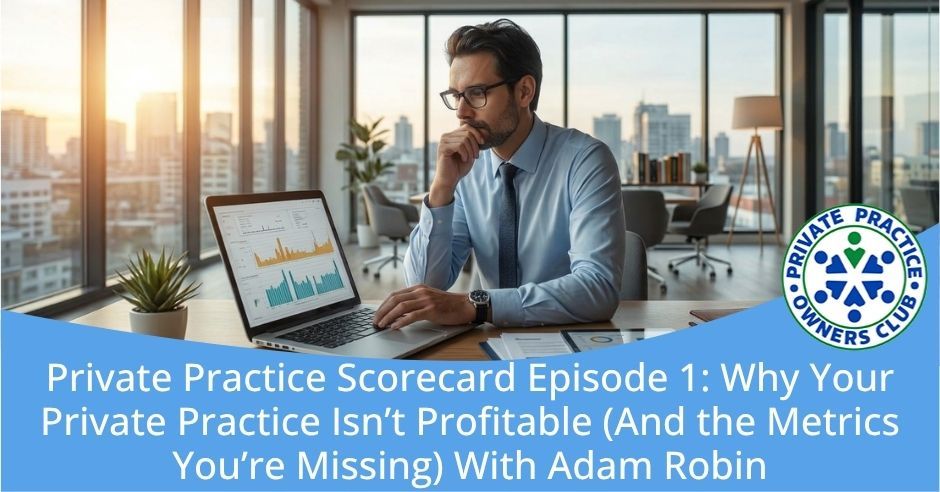
Most private practice owners think they understand their numbers. But when you actually ask them? They don’t.
In this episode of the Private Practice Owners Club podcast, Adam Robin introduces a powerful new series that will completely change how you run your clinic.
This is not theory. This is not motivation. This is a step-by-step breakdown of the exact metrics that drive profitability, efficiency, and long-term survival in private practice.
Because here’s the truth:
👉 You can’t scale what you don’t measure.
👉 You can’t fix what you don’t understand.
👉 And in today’s environment, “winging it” is no longer an option.
With declining reimbursements and tighter margins, clinic owners must evolve from clinicians into operators.
This episode sets the foundation for a 12-part series designed to help you:
● Understand your numbers without feeling overwhelmed
● Identify where money is leaking in your business
● Build systems that drive predictable financial outcomes
● Remove emotion and lead with clarity and control
● Increase visits, revenue per visit, and overall profit margin
💡 In this episode, you’ll learn:
● Why most clinic owners avoid financial metrics—and why that’s dangerous
● The two major shifts required to survive in today’s healthcare landscape
● How emotional leadership can actually hurt business performance
● What a “practice scorecard” is and why it’s your new superpower
● The 4 key areas that control your entire business (marketing, front desk, providers, billing)
● How to transition from reactive decision-making to intentional design
🚀 What’s coming next:
This is just the beginning. Over the next 12 episodes, Adam will walk you through:
✔ Marketing metrics
✔ Conversion systems
✔ Provider performance
✔ Billing efficiency
✔ Financial tracking
✔ And the exact tools to run your clinic like a machine
🎯 Key Takeaway:
If you don’t take control of your numbers… your numbers will control you.
🔗 Resources & Show Notes:
👉 Workshop: https://ppoclubevents.com/04-17-26-workshop
👉 PPO Club: https://ppoclub.com/
👉 Free resources: https://linktr.ee/ppoclub
💬 Love the show?
Subscribe, rate, and share with a clinic owner who needs this.
---
Listen to the Podcast here
Private Practice Scorecard Episode 1: Why Your Private Practice Isn’t Profitable (And the Metrics You’re Missing) With Adam Robin
Financial Diagnostic Questions And Private Practice Scorecard Introduction
Practice owner, let me ask you a question really quickly. If I came to your practice and I spoke with you or maybe some key leaders on your team, and I asked them just a few simple questions, maybe, "What is your average revenue per visit? What is your cost per visit? What are your minimum expectations for production? What percentage of your revenue are you spending on payroll, marketing, and operations?" Would you be able to honestly answer that question?
For most of us, the answer is probably no, which is why I am here. What I want to give you is perhaps what I feel is the most valuable thing that I can give you for free. I am going to help you walk through your very own private practice scorecard, one metric at a time. If you stick with me through this series, I am going to give you the playbook. I am going to give you what most people charge money for.
I am going to give you a superpower, one that helps you actually be the designer of your business and gives you the tools that you need to succeed, not just personally, but also financially. Let us get into it. Let us talk about the reason why I am here. Nathan and I have been really thinking this year about how to add more value to our audience, add more value to private practice owners. Our mission has always been to transform the lives of others. We want to transform the lives of 1,000 healthcare leaders in the profession. We are trying to figure out the best way to do that.
Time and time again, we continue to come back to this recurring theme, which is the one that we are all probably very familiar with at this point. It is this. Private practice owners, healthcare leaders, PTs, OTs, speech therapists, MDs, chiros, we are people-driven. We are emotionally connected to our people. We want them to win. We have this deep, empathetic drive to help others see greater possibility and opportunity in their lives. Period.
Tell me if this resonates. When people come to your practice, you just want to be present. You want to connect. You want to truly hear them. You want to acknowledge them. You want to touch them. You want to truly connect with them in a way that helps them feel seen, heard, and valued, appreciated, and feel like, "Maybe I am enough. Maybe who I am is enough to actually gain control over this thing in my life."
People-Centered Strengths Versus Financial Blind Spots In Practice Owners
Usually, it is their health, their mobility, or something like that. That is why we got into this profession. We got into this profession because we were like, "We are going to make a difference." Therefore, we are generally good at that. We are good at connecting with people at a very high level, perhaps higher than most people. Tell me this. You typically are a leader in your community.
You are a leader on your team. You are a leader in other areas of your life. Maybe it is your church, or maybe it is the community events that you are involved in. You stand out. You know how to connect with people. You know how to drive collaboration. You know how to drive outcomes with people. We are naturally good. We are gifted. We are wired to thrive within the people component of our businesses because all we want to do is help people.
We are natural people-pleasers. Where do we continually get stuck? The truth is, we typically are not as strong or are not as geared towards being successful with our finances. This means we do not like the metrics. We do not like the numbers. We do not like the "business side of things" because it is heavy and it is transactional in nature, which is almost counterintuitive to what we actually want to do. It feels sleazy. It feels weird. It is harder to digest. It is not something that comes very naturally to us.
Where do we keep getting stuck? The truth is, we’re often not as equipped or as financially prepared for success as we think.
That gap between where we are with our financial literacy and our operational excellence to where we need to be, there is a real gap there. We want to help you bridge that gap. We want to help you bridge that gap and make it easy and seamless because I have been talking to a lot of really successful people, people who are a lot more successful than me. Private practice is what I love, and I definitely am not somebody who has all the answers or has it all figured out. I have a little bit figured out, but I have so much to learn.
One of the ways that I learn is I surround myself with people who are smarter than me, who are like, "This guy has got a hundred clinics. Let me see if I can pick his brain. I want to learn about the way he thinks." I want to see what he sees, or she sees, right? I have these conversations with people as a student, as somebody looking to absorb and gather as much information and perspective about what is next in the practice owner journey and in the industry.
Urgent Need To Elevate Business Skills And Pivot Due To Industry Pressure
What I have found is that two very common, overarching themes are critical for us to get. Number one, this is key. We used to be, as private practice owners, it used to be okay, or we used to get by with average business skills, or even slightly below average business skills. The margins were there, right? It was easier to be successful financially. We would waive copays, and we would not really focus on the billing stuff and over-the-counter collections. We would get to it when we had time, and we used to be able to get by with that. Unfortunately, that is not the case anymore. Reimbursements are continuously declining and becoming a bigger and bigger challenge for us.
Therefore, in order for us to survive as an industry, private practice, that is, we must become above average and, if not exceptional, at financial operations and business literacy. It is critical for our survival because winging it and getting to it whenever we have time is no longer going to cut it because things are just too thin. That is number one. We must elevate our skills as business owners to be successful. Number two, we must pivot.
The traditional model of healthcare is no longer going to serve us. That does not mean we have to flip everything upside down and go, "We are dropping all the paying insurances and we are just going to do some weird stuff." We have to make some minor, yet impactful, pivots in the way that we deliver care and how we get reimbursed in order to create a future that is not just viable for you, but also for our teams and for everyone else. Those who pivot will survive. This is a big one, and I want you to sit with this because I care about you.
If we, as an industry, do not confront the brutal truth that number one, we must get better at business, and number two, we must pivot, if we do not do that, the only outcome to that is that we slowly start to erode and go out of business over time. Just a slow bleed over time, which will ultimately result in you shutting the doors. I know how heavy that is. Money stress is real. It creates real internal pressure for you, for me, for everyone. It makes it hard to show up and truly be present because we are worried about survival. That is a very hard place to be for our patients, for our team, and for the people we love most, for our families, for our kids.

I want you to go on this journey with me. What I am going to do is I am going to walk through a series. It is going to be called the Private Practice Scorecard, One Metric at a Time. It is going to be a series of podcasts and YouTube videos, and they are completely free. Never has it been easier to get real, free, high-level business education than it is right now. This is exactly what I paid thousands to learn from other business coaches and mentors in my past. I am giving it all away, completely free.
My goal is to elevate you, to empower you, and to build trust with you. This is going to be a 12-part series, where we are going to help you know your visits, know your revenue per visit, and know your cost per visit, so that you can see exactly where money is leaking. This is going to be a full masterclass, and it is not going to be high-level stuff. This episode is going to be a little bit high-level.
This is the introduction. I am just sharing the vision with you. I am going to talk through why this matters and what the overarching goal is. Starting next week, when we get into our first chapter, our first real application chapter, it is going to be very hands-on. I am going to give you step-by-step guidance on exactly what actions to commit to to create outcomes. I am going to give you strategies. I am going to give you tips. I am going to give you access to my team and me. All you have to do is reach out to us.
We will answer any questions with you to help you make a real financial change in the business. Here is a high-level overview. I mentioned, it is going to be really more about the vision, about the overarching theme, about the goal. I am trying to get your interest in this because this is valuable, this is real stuff. Honestly, I am sharing this with you not for any other motivating factor other than that I truly believe this is the information that will make the biggest difference for you.
I am going to write that down and say it one more time. I am sharing this with you not because I am smart or there are no hidden motives around this. The single reason why I am sharing this is I honestly and truly believe that this information, based on all the work I have done with practice owners, all the conversations I have had with the smartest owners that I know from all the conferences that we have done, from all the vendors that I have worked with, from all the sponsors that we have had and communicated with and by whom we have been advised, I truly believe that this is the most valuable information that you can get that will make the biggest difference for you and your business.
Core Operational Metrics Across Marketing Conversion Clinical And Billing Systems
That is why I want you to know this. As I mentioned, it is going to be a 12-part series, and forgive me, I am looking down at my notes. Episode number one, goal, vision, high-level overview. Once I go through this, I am going to break down what listening and implementing these things will ultimately get you. Stay tuned. That is going to come towards the second half of the show. The first episode, the one that we are going to do next week, is going to be all about marketing drivers. How do I generate leads? How do I generate sales opportunities inside the business?
Specifically, what metrics do I use to measure the success of that? That is going to be all about marketing. For your practice owners who are like, "I need more new patients, I need more leads, I need more sales opportunities." This is going to be for you. I am going to break it down. I am going to show you how to measure it, what actions to specifically commit to that will give you the biggest ROI on your marketing dollars. That is number one.
The second bucket, which will be a series of multiple episodes, is going to be the front desk and patient care coordinator. Think about it. Lead generation is where you start. Conversion is the next step. That conversion happens at the front desk or at your administrative side of the business. It could be a virtual assistant, or it could be whoever is doing the intake process for new business. Typically, it is the front desk or some type of sales professional, who could even be you as the owner. We are going to go through four primary metrics within the front desk.
Lead generation is where you start. Conversion is the next step.
There are tons, but we do not need to focus on tons. We need to focus on the four primary. The core four is going to be lead conversion percentages or referral conversion percentages. How do we take that lead who is like, "I'm interested," and convert that to a new patient that is on the schedule, ready for a sales opportunity? That is number one. We will do a whole episode on that. Number two. The new patient arrival rate and the new patient arrival rate percentage. Arrival rate is important, but how many times have you had a new patient on the schedule and then they cancel?
It is a new business. That is the worst one to lose for so many reasons. We want to treat that with its own special episode because these are your VIP new opportunities that we want to have very specific intentions around in order to ensure that they show, so that we can create impact. Number three. Arrival rate, general arrival rate. Once they convert and they show, how do we keep them on the schedule consistently? What are the specific things that we do from the front desk to clinicians to technology to ensure that our show rate is as high as it possibly can be? Number four. Over-the-counter collection percentages.
Over-the-counter collections are the first financial touchpoint inside your private practice. It is where we typically start. A lot of things happen during that intake process. Clarifying over-the-counter collections and driving that financial touchpoint is really key. All of these conversions and arrivals, all of this is going to lead to more new patients.
Marketing does not give you new patients. Marketing gives you leads. Conversions create new patients. Conversions create new patients. How do we maximize our opportunities to create new patients? Going on to the next bucket, we are going to do episodes on every single one of those. The next one is going to be provider performance, our clinical team. What are the metrics that we use to drive efficiency, utilization, and production while we are delivering care?
It’s very important. We are going to do two primary episodes. Number one is going to be two statistics. One is going to be our average frequency per week, essentially measuring the average prescribed frequency of that plan of care every week. Included in that episode, we will do the average visits per evaluation, which is more of a duration. One is more of a frequency, one is more of a duration. How many visits? This ensures that we are maximizing frequency and duration ethically and compliantly, ultimately driving utilization and production up and maximizing it, not beyond what is ethically appropriate, but maximizing what is ethically appropriate and elevating production.
Lastly, the second episode for our providers will be our units per visit. Here is the thing. If we have a bunch of visits on the schedule, that is great. That is awesome. What a great opportunity. If they only stay for a minute each and we are not able to bill for those visits, then it does not really move the needle for us financially. We want to ensure that we have a unit per visit expectation or target for our clinical team, such that for every visit that is on the calendar, we can maximize our billing opportunities, and we can deliver value in a way that is consistent and congruent with that value and billing.
We can code it well, and we can have a very stable revenue per visit from a billing and coding perspective. Those are the two episodes there. The next section is going to be two episodes for the billing team. By the way, going back, the provider performance, the way that you bill, that is your second financial touchpoint inside the business. The second transaction happens there. The third transaction is your billing and collections team. How do we ensure that money comes back into the business? We are going to be doing two full episodes for the billing department.
The first episode is going to cover three metrics. Denial rate, percentage of collected versus projected, and the aging report, or the percentage of collections that are outstanding beyond 90 days. We want to tighten those things up and make sure that we have processes in place to drive efficiency with those three things. The second episode is going to be our average revenue per visit.
How do we make sure? I am back, and I had a little camera issue. Average revenue per visit. How do we ensure that we are driving our revenue per visit up? How do we do that? We will do a full episode on our average revenue per visit. The next bucket is going to be our accountant and bookkeepers. This is our fourth and final financial touchpoint inside the practice. We are going to be looking at how to track very clean financials and look at a few metrics: gross income, gross expense, net profit, profit margin, and cost per visit.
Specifically for gross expenses, how do we break those expenses down in a way that is easy to understand and that actually helps us make decisions and set budgets inside the company so that we can drive profitability? Expenses drive profitability. Expenses are just as simple as going to help us. Expenses are a metric of efficiency. How do we keep as much money in the business without losing it through other expenses?
Profitability is a metric of efficiency. It is not typically a metric of volume or top-line revenue. What I have seen, and Nathan will attest to this, is that most businesses, big or small, if you are having cashflow issues, typically the best place to start is by managing your expense lines first. How do I drive down expenses in a way that is efficient and streamlined so that I am plugging all of the holes inside of the business? This will actually give me some breathing room between my income and my expenses, and that is where your margin lives.
Profitability is a metric of efficiency.
That is where all the possibilities live. That is where your freedom lives, right there, which is hard. That is where all of your systems and your organization, your discipline, and your routines, all of those things set budgets and boundaries on your behavior and on your spending, which is the thing that creates expense. That is a very critical episode, so make sure you stay tuned.
Business Modeling Tools KPI Dashboard And Pro Forma For Decision Making
Lastly, we're going to talk about the tools that you need to actually use this, and I am going to give you the tools for free. These are going to be the tools to help you get all this out of your head and just see it on a spreadsheet, just like a calculator. I think about this all as just a very big math problem. It is a very big, sophisticated, or complex math problem. It is not that complex, but it is complex enough that it is hard to hold it all in your head because there are a lot of moving parts, twelve episodes. Nobody gets overwhelmed when you use a calculator, and you have a tool. We have all taken algebra.
You plug all your numbers in, you put all these parentheses in, you put your cosines and all this stuff, and you press enter, and you know the number there. It is like, boom, that is the number. I trust it. Two plus two is four. I feel certainty with that. I may not like the number, but at least I know exactly where I stand, and I know exactly what I can do about it to fix it. That is literally how you remove emotion from the business so that you can be more offensive with how you are designing your model.
The two tools that you are going to use are a KPI dashboard. In your KPI dashboard, you're going to be your lagging indicators, meaning what happened. I am measuring the outcomes that we had. The second tool is going to be a pro forma, which is going to be a tool that we use to make projections, to make projected financial outcomes based on the things that we want to operationalize in the business.
All of this is going to help you create a model of doing business. A model is very simply a series of activities, rules, and structure on how you deliver care that leads to a predictable financial outcome. Most of us do not have a model. Our model is to show up, treat patients, and figure out what happens. When you design a model, it says, "We are going to take these insurances, schedule at this frequency, measure these KPIs, and compensate our team in this way with this much."
This sequence of decisions and commitments, if executed well, will give us that blank financial outcome. That is your model. That is your blueprint to financial success. You can apply that to your business. You can open up multiple locations with that model because it is consistent and it is predictable. You are in control of the financial health of the company. All that is going to give you a model. How are all these episodes going to work?
I am going to break these down into four parts. Anything outside of this would be just a little extra. Number one, I am going to tell you what the problem is. I am going to outline this problem, and these are the symptoms that you will experience if this metric is low or if this department is not ideal. These are the objective symptoms and the emotional symptoms that you will experience with yourself and your team. This is the problem. The second thing is that we are going to discuss the statistics that we actually use to measure that problem, whether good or bad.
What is the objective tool that we use to objectify either success or failure with this problem? I will give you the metric. I will tell you how to calculate it. I will tell you what I have seen as the best way to find it. I will give you everything I can about the stat. The third thing is, I will share with you what will happen as a result of you fixing this problem.
What will that open up for you? What will that feel like for you, for your team? What will that do to your bottom line? Fourth, the most important, the part that everyone likes. It is how to fix it. I am going to give you the big. I cannot give you everything because I do not know everything, but I am going to give you what I know. The best, simple things, activities that you can do to actually fix the problem. I am going to give you step-by-step guidance, tools, and SOPs. All you have to do is go and do it.
If you do it, you will drive outcomes in each of these departments. What is the ultimate goal of all of this? Why should you even listen? Maybe you should not. If you are making a ton of money and you are super happy, maybe you should not. This series is going to be purely financial. This is going to be an objective series. This is going to be a series where we are going to try to put our blinders on and think purely from a financial perspective.
That does not mean that the people component of the business or the systems of the business are not important or are not worthy of consideration. All of those things are true. We are going to solve those problems in a different episode, in a different series. This series is going to be what are the behaviors that I would need to commit to to drive financial success, period.
Through that lens, we are naturally going to create some limitations, like "What about this? What about that? What if my team does not like it? Is that ethical?" We are going to be confronted with those questions, and we can solve those at a later time in a different episode, or you can reach out to me, and we can have a conversation about it. For now, we are just going to focus, trying our best to stay in this lane so that you can be more objective. The objective outcome that we want is three things. Number one, more visits.
Final Business Model Outcomes: More Visits Higher Revenue Per Visit And Lower Cost Per Visit
If you are a private practice owner, one of the key metrics that you look at is how many visits a week we are doing. How many visits a day are we doing? More visits mean more income, which means more impact, more success for the patient, more success for you, for the team, and for the community. Everyone wins with more visits, typically. Number two. More revenue per visit. As mentioned, more visits are not the only thing.

We have to make sure that we are getting paid a lot for each visit. If you follow the formula within this framework, you will see a noticeable increase in your visit volume and in your revenue per visit, which will give you much more favorable income and top-line revenue. The top of that profit and loss statement, the one that says, "This is how much money we made last month as a company," will go up. You will see that the third outcome is decreased cost per visit, which is typically the hardest thing to get right. That is the efficiency piece.
If we button up and create systems, habits, routines, metrics, and accountability around them that drive efficiency and that allow us to deliver care without spending as much money, we will create a gap, a healthy gap between our top-line income and our bottom-line expenses. It is within that gap that creates profits, which is what our industry needs more than anything.
There is a way to do this. I promise you, you can do this. You can carve out 5%, 10%, or 15% more profit margin if you follow these simple steps. That is what I want to give you, and honestly, it is literally the most valuable thing that I can give you. It is the most valuable thing I can give you. You will be able to listen to this on a podcast.
There will be a YouTube video. You will be able to tap into the YouTube channel. You will be able to connect with my team or me. There will be resources. You can email me. You can text me. There will be ways that you can connect with my team in the show notes or somewhere on the YouTube channel. You can join the Facebook group, and you can just post your questions. A lot of people in that Facebook group are going to be tuning in to the series, so bring your questions to the Facebook group. My team and I are there, and we will answer them.
We will help you get over the hump. We will help you implement it. All you have to do is dedicate some time every week to listening to these, save them, bring your pen, bring your paper, write down the specific action items and the blueprint, and go and execute with your team. Execution is the hard part. We can sit around and talk about theory, and we could talk about all these ideas, and all of those things are good, and they create perspective.
The hard part is how to drive behavior change in myself and in my team. That is where execution lives, and that is what separates winners from losers. It is the execution that is going to drive home the life and the business that you want, and you are the only person who can do that. Do not make the mistake of listening to all this and saying, "I listened to that thing once," and not doing anything about it. That is the biggest failure ever.
Do not be that person. Be the person who can actually commit to some type of change. If this sounds of interest to you, I want you to stick around. I am going to try to put these out every week. They are yours. It is my gift to you. It is literally everything that I know about this stuff. If you want to learn more, if this is your first time tuning in, go ahead and join our Facebook group, subscribe to the YouTube channel, and get involved in the private practice owner's club.
We will be diving into this together. Make sure that you have everything that you need to connect with my team and me. I will see you next week for the first episode, the first actionable episode, where we are going to tap into the marketing drivers inside your business. My name is Adam, and I will see you next week. God bless.
Important Links