Most physical therapists believe better outcomes come from better hands-on skills. But what if that’s only a small part of the equation? In this episode of the Private Practice Owners Club podcast, Nathan Shields sits down with
John Woolf, founder of
Patient Success Systems, to break down a powerful (and uncomfortable) truth:
👉 Clinical outcomes are driven less by technique… and more by connection.
Backed by research and real-world experience, John explains why only a fraction of patient results come from the actual treatment—and why the patient experience, communication, and relationship are what truly drive retention, engagement, and outcomes.
This conversation dives deep into what most clinics overlook:
not just how you treat patients—but how patients feel when they’re with you.
💡 In this episode, you’ll learn:
● Why technical skill may only account for a small percentage of patient outcomes
● The real reason patients stay, refer, and complete their plan of care
● How “connectability” and relatability impact retention and satisfaction
● The difference between delivering care vs. creating a patient experience
● How to measure and improve patient relationships inside your clinic
● Why some therapists outperform others—even with weaker technical skills
● Practical ways to train communication and connection across your team
● How small experience upgrades (front desk, environment, tone) drive big results
🚀 If you’re a clinic owner or provider who:
● Struggles with cancellations or drop-offs
● Wants patients to stay longer and refer more
● Feels like outcomes don’t match clinical skill
● Or wants to build a stronger, more scalable clinic culture.. This episode will completely shift how you think about care.
🎯 Key Takeaway:
Patients don’t just come for treatment. They stay for how you make them feel.
🔗 Show Notes & Resources:
👉 Learn more about PPO Club:
https://ptoclub.com/
👉 Explore resources:
https://linktr.ee/ppoclub
💬 Love the show? Subscribe, rate, and share with another clinic owner who needs to hear this.
---
Listen to the Podcast here
The 20% Rule: Why Your Technical Skills Are NOT The ONLY Reason Patients Stay Or Get Better With John Woolf, PT, PhD
Research On Treatment Outcome Attributed To Actual Treatment
I've got a past guest coming back to us, John Woolf, who is the owner of Patient Success Systems. It might've been around 2021 the last time I had you on. We were talking about the patient experience at that time as well. You are and have been committed to the patient experience. What we're talking about is very interesting. You're going to share a lot of information about it. I'll relate what I can to it. It's about how whatever we're doing with patients clinically has significantly less to do with our actual skill, the technicality of our therapy than it does other factors. Teeing it up like that, where would you like to start the conversation?
Best Outcomes Are Not Only From Technical Treatment
It's great to be back. This is probably an expansion of the conversation that we started, which is the idea of patient experience. I suspect if I was beating the same drum that I'm beating, it was the idea that a whole lot more goes into a clinical outcome than just the treatment techniques that we do. I had known that because I was a private practice owner. I recognized that.
We had nine clinics. We had a lot of therapists. I realized that those who were getting the best outcomes were not the same therapists that were the best technical treatment-wise, trained. You can do the best. Some of them were doing the best possible cervical mobilizations and manipulations. Yet they weren't keeping their schedules filled. They didn't necessarily get great reviews from their customers, from their patients.
It just led me to wonder what it is that keeps a patient and moves a patient forward in a treatment plan to keep them engaged. I suppose a lot of us have been thinking about this. I got super curious. After we sold our clinics, I just went back to school and got a PhD in Psychology. To try to really get into the “Why does this work? What's so important about a therapist that communicates well with you and connects with you well?” I took a deep dive into the content and learned some stuff.
I saw a lot of this myself. You're putting words to it that maybe I use different vocabulary over my time. I remember distinctly hiring a clinic director at one location. His skills were questionable. I knew that going into it. I also knew that he had a personality type, an ability to connect with people that I wasn't worried about. I don't know why I wasn't worried about it. I probably should have been more like, “We need to shore up your skills here and get you set up.”
We were starting from ground zero. This was a new location. He got the clinic full. Patients came to see him. Let me share this one anecdote. It lends to what your claim is and what the studies are backing up. He eventually had a McKinsey-certified therapist join his team. He saw this one patient a few times and said, “You would do well with my other provider, right in line with what you need. The McKinsey protocol would be great.”
Send them over there. Three weeks later, the patient gets back on his schedule. He's like, “How are you doing?” He's like, “I'm doing great.” He's like, “Why are you on my schedule?” He's like, “I like how you provide care.” He couldn't understand. The patient was like, “I want to come see you. That guy has the magic hands, but I want to come see you.” That lends to what you're talking about a little bit. Could that therapist have gotten him to that point? Maybe. The patient was led back to him for one reason or another.
You probably recognized it when you trusted this guy in the position. He had it, right? He had something. What is the “it” that some therapists have and other therapists don't have? That was my research question. Is there something that a therapist has, the “it” that others simply don't have? Sometimes, you have a connectability, or we call it a relatability, that's innate. Innate is you just naturally have it.
Sometimes, we can point out people who naturally seem to be friendly, connectable, affable, and a bunch of other cool psychological descriptive terms. Other people who in spite of the fact that they're really well hands-on trained may or may not be as connectable. There's this balancing act of, what is the “it” that some therapists have and other therapists don't have?
If somebody doesn't have the best it, the best connectability, can you improve that connectability? Even if they aren't born with it or they haven't practiced it their whole lives. Can it be, nevertheless, improved as a result of training? That's what I keep thinking. I started to shift the fact that we needed to not just train great hands-on techniques. We also needed to train the fact that you can be more connectable to more successfully connect with a patient in a way that creates, what you just described, this perceived value.
We needed to train not just great hands-on technique, but also the ability to be more connectable—to build stronger patient connections that create real perceived value.
The value for that person wasn't the best extension exercises for their back. It was the care and the connectability. There are a bunch of different words you can use here. The camaraderie that you have when you're in a treatment environment. Someone who's there with you as you progress through a thing. More and more that's really what patients want. This ability to connect, feel like they belong. That they're cared for.
That they're being heard. That we're aligned. You understand what I'm looking to do. Your treatment falls in line with that. Part of it makes me think it goes back to something as simple as. “If I'm going to spend a good portion of my week with you, two or three times a week, separated from work, family, friends, hobbies, or even nothing.” Which some people would rather do than therapy.
“I better like you. If you're a jerk or if I don't like you, then good luck in staying engaged in that physical therapy course of care.” That means a lot. Sometimes, I'll judge owners, especially once you're starting out based on their personality, frankly. I wonder how this guy's going to do. I wonder how this girl's going to do. They don't seem very affable. They don't seem very relatable, to use your word. I'd like to see how this goes.
I have seen people who are like that, that are not as likable personality-wise. If they've been successful, it's because they've surrounded themselves with higher than normal people. The people around them love being with people from the front desk to support teams to everyone else. They're above average extroverts who want to know what's going on. They have to actually, it seems like, overcompensate with other personalities on the team.
I wonder the degree to which they do that automatically, if there's some true intentionality.
They recognize the fault.
Do they actually recognize the fault? This is probably what you talk about regularly. As a being a successful leader in a business, you really have some reflective capacity to know where your strengths are not. If you surround yourself with people like that, even we got to the point where we were interviewing therapists.
They have to be capable. They really have to be good diagnosticians. Treatment screening, treatment plans. Our number one variable was the degree to which they could connect. If you can't connect and keep that relationship, we call it the therapeutic relationship. If you can't do that, then the chances that you're going to be able to successfully put all those cool manual skills in play decrease.
The patient, like you said, they've got other important things to do in their lives. You used the word like. To be likable, that's a pretty good descriptor. In part because you are spending time with someone. I always try to teach it this way. Imagine a patient, we can all do this. They're busy. They got a lot going on. They have some pain. They have some things. You finally get them to the point where they're just feeling better but not great.
You know that if you were to continue on a treatment plan for another, I'll just use arbitrary, two and a half more weeks or eight more visits, you could get them functioning so much better. Yet they get feeling better enough. They're like, “Is it really worth going back or am I okay?” The deciding factor oftentimes is the perception that I'm not just getting cool exercises, which are good and hands-on care. I'm also experiencing something when I go to that place. Although I had to drive there, I had to park.
Your co-pay?
The perception of the value is high enough. If the therapist is relatable, that relatable skill is one. You couple the idea, the other skill of communication that helps them understand the treatment plan and the importance of a treatment plan. I don't like using the phraseology of selling a treatment plan. Everybody sells. That book's out there.
At the same time, what we're doing is we're collaborating with a patient to create a treatment plan that they want to invest in. Investment means the ongoing realization of the value. They're getting better. I enjoy the process. That's a variable that's different for each person, because each person, each patient is going to have a different criteria for what's really valuable to them.
Each person, each patient, is going to have different criteria for what’s valuable to them.
Improving Patient Experience Through All Senses
I've noticed as I've coached some clients. Those who have focused on the patient experience, for whatever reason. Maybe they got some feedback. Maybe they want to improve engagement. Maybe they're looking at some metrics to improve their business altogether. These things would ultimately improve patient results as well. Those who have focused on the patient experience and improving the different touch points.
One client I recall, he wanted to make sure when a patient comes into the office, they're having positive experiences through all senses or as many senses as possible. There needs to be good smells. The front waiting room, maybe even the treatment room needs to be aesthetically pleasing. They need to be hearing nice things. Maybe there's a small waterfall in the corner or some nice music. That's enjoyable, pleasant, not off-putting.
Trying to touch as many senses as possible to make it a pleasing experience, but also really focusing on what that interaction at the front desk looks like? What words are we using? How much are we asking them to do? How easy is the process? How simple? How fluid? How can we get them from point A to point B in a pleasant way? How can we make that patient experience a five-star experience? When they did that, the frequency of visits per week improved. Cancellation rates go down. People stay longer for their protocols. I've seen it in a number of clients that I've worked with.
Sometimes, your clients are seeing it likely in the way that you're guiding them into it. If you approach it from a true customer perspective, not unlike a Marriott would. They have customers that are clearly defined with clear values, a clear value proposition for the customer. That is to provide a five-star experience.
We, as clinicians in the healthcare industry, that's not necessarily one of our very top criteria. How do we provide a five-star experience? Yet, when you apply that concept, because you know it's important, not just for business success. I'm a nerd on the clinical outcomes spectrum as well, that it actually makes a difference in clinical outcomes.
This is where I got squirreled up in just part of my research and scholarly work. What are these mechanisms? Why? I totally buy into this idea that this experience is critically important. Obviously, I can talk about it all day. Part of my curiosity is like, “Why does this work? How does this work?” I love it. Helping other people understand it and teaching the skills, this is fantastic. There's still, in my mind, a curiosity. “Why is this so important to patients?”
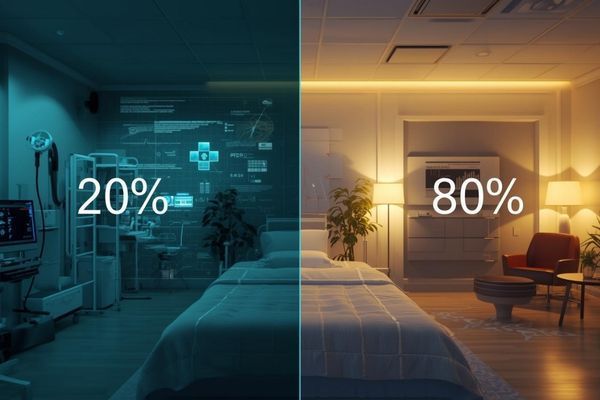
The research recently has opened the floodgates to asking these questions. Many of us in manual therapy are really investigating what these mechanisms are. Why is it so important to have this connectability? The research over the past year and a half that really rocked the landscape. This idea that only about 20% of a treatment outcome can be attributed to the actual thing that you do to a patient. The actual treatment itself, that accounts for only 20% of the total outcome.
That's amazing.
I thought so, too. That's a number. The methodology on some of these papers is being questioned. That number gives everybody pause to say, “Wait a minute, there's a lot more going on here.”
Even if they were off a little bit.
Let's say you're off by 3% or 5% or 10%.
Maybe it's 40- 60 or 50- 50. That still means that a majority of what you're providing technically has nothing to do with what you're doing technically.
I'd even go as far as to say, the technical skill, this is where we're thinking about it. Sometimes, we think of a technical skill as the perfect application of a mobilization or the application of some motor control training. That's a technical skill. I go as far as to say, the language that you're using is also a technical skill. The emotion state that you show up with is also a technical skill. These are technical insofar as they're also techniques.
If you work on your technical skills, and you know that 80% of your outcome could be, might be, is attributed to the things beyond the technical skills you use with your hands or your clinical reasoning to apply a treatment plan. It's about the relationship. We must slow this down and go, “There's a whole lot more technical skills that I need to gain in communication, in interpersonal emotion regulation. These are all technical terms.
There's a lot of technical terms that we use when we use and put our hands-on patients. There's a whole technology there. Let's just say it that way. The technology of getting a thing to move better or a muscle to activate better. That's great technology. The technology of connecting with people to create a healing response in a therapeutic environment. There's a bunch of cool technical stuff in there. I could talk about that more than anyone is interested in hearing it probably, but it's wicked cool.
I'm thinking about an owner who maybe has one of these people on their team. That could benefit from learning how not to apply their technical skills better, but the other related skills outside of what they can do with their hands and with their brain. Where would you start with them as an owner who has that kind of person? Maybe with the optimism of saying, “Maybe we can train this person to be better at their relatability to the patients, their connectivity to the patients.” Where would you recommend an owner start with helping that person?
Measuring The Therapeutic Relationship For Management
There are very few of these courses and trainings out there available. If you compare those skills training to your shoulder courses or your knee courses, those are easy. There's plenty of those. Full disclosure, I've been teaching this stuff for a long time. It'd be a little too self-promoting for me to say, “Call me or go to my website.” I won't do that.
I could say, though, also that if you're a business owner and practice owner, there's the old saying of “What gets measured can get managed.” You can't manage what you can't measure. One of the first questions I ask for companies that I do systems consultation with, relationship-centered care is what I've basically been promoting.
If you're not measuring relationships, it's very difficult to manage it. The question I ask business owners is, “How are you managing, how are you measuring your relationship with your customers?” Most people are going to say, “We use an NPS” or some equivalent, which was part of my dissertation for a while.
I kicked it out because the validity was so difficult to actually define. The construct was a little sketchy. Does it really apply to healthcare anyway? The answer is, I think so. It's useful. It's a starting point. How do you get a little bit more granular? Not asking more questions on the survey, but asking the right questions on the survey?
An MPS score is going to be post facto. It is typically done their thing. We're talking about how do you keep them engaged in the moment?
How do you assess how engaged they are, how a patient is doing and their perception of how it's going. That has to be done at the first visit and with each therapist. It's a simple, easy set of questions that ask the degree to which the patient feels like this is a good match. You ask a question like that and their patient's brain is going to go, “A good match.”
What does a match mean?
They probably couldn't even describe it, but they could feel it. I can see that. That's almost what we're trying to explore. Is the degree to which a patient feels like they belong. That's a really key component in the experience of the patient. Do I belong here? They're going to formulate the sense of belonging in the very first phone call they get from your clinic. The very first time they walk in the door.
The number of experiences, their full sensation of sensory experiences are going to factor into it. The very first things you say to a patient when they come in. The degree to which you match the ways in which they're telling their story. The time that you give them to tell your story. The way that you affirm some of the emotions. The empathic cues and a bunch of other cool technical stuff.
You have to be able to measure it and you can. We have some really scientific-based surveys that are out there. We're trying to leverage those to make them a little bit more practical for business owners to go, “How do I scale these questions?” We did it pretty successfully. We incentivized our front desk and all the colleagues on our team. The most important part of the survey-based incentive is participation.
We almost don't care about how you score necessarily, because what we really want is the information that we can help work and improve our team. We need participation. Each therapist essentially was incentivized. A very practical incentive to get a return rate on these things at 95%. We need the information. We're not going to penalize you or reward you for how you do on the information. It's the information that helps to create this potential growth that we're trying to get.
If you can measure it, you're already getting a sense of who. With the interesting part, you start correlating those outcomes to the other KPIs that you're looking at. What are their cancellation no-shows? What are their visits per plan of care? What is the return rate of that patient to that therapist? The MPS is always a part of that too. If you've got a really robust data processing engagement platform with your customers, you’re also tracking the number of referrals that that patient actually made to your clinic, which also matters.
Systematizing And Training Relatability Using Video Recordings
I remember one of my first coaches highly recommending, I never did it, that I videotape my interactions with patients. That way, what comes to me naturally, could start being systematized and then trained into future providers. There is a reason why most owners are successful off the bat. They have some kind of magic that they can't speak to because it comes to them naturally. It's innate.
If you were able to visualize it via a recording of some kind and then set up some structure or make some notes about each one. Those things could be trained into other providers. “This is how I did this. Watch this clip of this video. This is where I feel like I'm relating to the person. This is where I'm re-wording their problem to represent.”
“Am I clear? Are we understanding we're on the same page that this is the issue? Am I clear as to where you really want to go with this? What are your goals? Can I restate those appropriately? Am I matching maybe tone levels? Are they coming in really depressed? I'm up here with cheerleader energy, that's not going to mesh well. Am I doing appropriately there?”
There's a number of those things that you could do. As you're talking about and I'm thinking about, those are ways that we could train in some of that relatability, likability. Like I said, most of us who do have better metrics, patients are coming more frequently. We have less cancellations. The owners tend to do really well at this because they're incentivized to do really well at this outside of their technical skills. They would do well to train it in that regard.
That is a training methodology. Sometimes, we have words for what we're training. This is partly what I’ve been exploring for some time. Sometimes, we're doing something really well in terms of communication, but we really don't know what we're doing. I teach a class on this stuff, a content class. People show up and they go, “I've been doing that.” Probably, they go, “I didn't know what it was.”
As soon as you can label it, as soon as you can name it, the chances that you can teach it in a scalable fashion increases. It's almost like you can't. It's difficult to teach something unless you know what it is that you're teaching. All the way down to the granular level. You said it really well, Nathan. You said if someone's up here and the other person's down here.
It’s difficult to teach something unless you know what you’re teaching.
If the patient's down here and depressed and the other therapist comes in as a cheerleader. You have a discordance, you have this incongruency between emotion states. This is all fancy jargon stuff. The way we teach that is called pacing. You have to do your own state management. You have to figure out how do I, first of all, calibrate to how that patient is?
Which means I have to have my own mindfulness that there's a gap. I have to be aware of my own emotional state, which means I have to have a reflective capacity. To be able to know exactly how and if I even want to match and meet that patient where they are. That takes some resiliency in and of itself. Sometimes, like you said, you don't have that awareness of where you are unless you see it in the way.
I like the video thing for a lot of reasons. One way that people understand it pretty darn well is called game film. You have a game and you remember these days. Every team after a game goes back through the game film, they figure, “What'd you guys do? What'd you do there? How'd that work?” The intent of that is simply a process of improvement.
You said you can't see what you're doing when you're the person doing it. You see it from the outside. This is the foundation for the highest level of training. There's two parts of training. What you're talking about is self-reflection, taking a look how it goes. The other is, like I just mentioned, you have to have a language for what you're doing. If you don't have that, it's tricky.
Using Language And Checklists To Teach Relatability Skills
I could see where taking that video recording a step further with maybe any of your providers. Part of their onboarding process is we're going to record how you're doing in those initial evaluations and some of your follow-up visits. See how you're doing according to these things. I like that you're saying, “Put some words to it. Are you relating? Are you restating? Are you synchronizing?” Almost like a checkbox.
There could be a checklist to this is how we relate and this is how we align with our patients to get maximum engagement. It's checking these boxes. If I can see exactly what you're saying, if you have words to them, then that helps them understand, makes it more concrete. It's less ethereal, obtuse or obscured. It's real. There's some mass to it if you can put the word to it.
I saw this again. I'm sharing these examples. They come to me as you're talking. I had another client, a super successful clinic, and many providers. Her boyfriend kept telling her, “You guys need to figure out what's your secret sauce.” She's like, “I don't know. Patients keep coming to us. They love coming to us. We're overflowing with patients. I don't know what the magic is.”
Great problem to have. I said, “Why don't you interview your patients and maybe even some of your providers? Let them tell you why they keep coming back.” Again, she wasn't aware of these things. They just come naturally to their clinic and their culture. Once she got some words as to what made her culture special.
What that magic sauce was. She can actually systematize it. “This is how we keep our magic sauce. This is if I'm going to open up a second clinic. We're going to make sure we do these things. We have the “magic sauce” and we have words to it. We can put a system behind it to make sure it's felt and continued on past me.
The biggest challenge of scaling, opening a new clinic is replicating that environment and that culture. What you're speaking to really well, we both were brought up in this idea that as a clinician, in many ways, we're clinician researchers. We have an N of one. We have a patient in front of us. There we are trying to discover, do a research project, assess, make an intervention, reassess.
It really is an ongoing research project. In businesses, I hope we're doing the same thing. I know you're teaching people to do this. What you just described is a brilliant approach to what's called qualitative research. Qualitative research is just that. It's not the hypothetical question where you're setting forth a hypothesis. You're simply trying to understand the lived experiences of people. In this case, the patient.
I remember a similar story where a patient walks in. She was a return client. She was going, “You know what? This place just feels good.” I was like, “What do you mean? What does that mean? What exactly are you talking about?” “I don't know, but you walk in. You just get a feeling like it feels good.” That's good. You want it to feel good. People generally are coming to us because they're in pain. They want a place where they feel good.
When you ask those more granular questions about, “What specific sense do you get? What do you feel in your body when you walk in?” Some of these are the qualitative questions you ask in research. “Give me an example of other parts in your life when you feel this.” If you ask these questions often and long enough, you're going to get a very full understanding.
This is what we do in research already. We ask these questions to try to understand what are the lived experiences of our patients. Like you said, if we can understand it well, with some sense of validity what they're really experiencing. Not what we think they are. There's a certain amount of rigor that goes into this research.
Can we apply that? Can we actually scale it? The answer is yes. As long as everybody, top to bottom. meaning the leadership and the line workers at all levels have a full appreciation for the value of this kind of training. What we struggle with sometimes in physical therapy is that we're physical therapists. We think that our primary offering to the client is that we're technical, physical experts.
That's often fed by this idea that it's patient-centered care. That it's all about trying to help somebody's knee move better. No, it's probably more likely helping to guide a patient through an experience. Part of which is to improve the function of their leg, their knee, them, and their lives. It also connects with them on this journey, which you have to be prepared and trained to be able to do.
I could see where if you would ask many therapists about a five-star experience in your clinic, the majority of what they're talking about would land towards the technical treatment of that patient. If they're going to get a five-star experience, they're going to get these physical results after the fact, which are important.
What we're saying is maybe they're not as important as you really think they are. The studies are showing that they're not. That the more important aspect is truly the lived experience. The experiential aspect of the entire thing. As soon as they walk in the door, maybe even from the phone call. What does that entire experience look like? It's super comprehensive and not just focused on the technical aspect of it.
The idea that what people need. I've backed up and tried to understand, what does the healing literature actually talk about? How do people actually get better? What's our role in this? Any healthcare provider's role? This research is good. It's good in so far as it's evolving rapidly. One of the main mechanisms that we understand, the most important part is the relationship.
In any way in the journey, everybody knows what this feels like. As soon as you feel like something's not quite right, you want someone else to help. Sometimes, you don't exactly know what that something else is. You know that you need someone else. What patients often struggle with is, “Who's the right person to help guide me?”
I don't know about you, but it just seems in our own house. My wife has these horror stories about a doctor who just doesn't listen to her. The fact that you get four and a half minutes with a provider before they walk out on you. I'm also seeing some examples where I've watched a neurologist work with my wife. That person really slowed down, listened, asked stories, and said, “That must be terrible.” She did some empathic tracking, some backtracking, some summarizing, and all those cool technical things that I'm super familiar with. I'm like, “Nice job.”
“We'll come back and see this guy.”
It was a lady. I can't tell you if there's any difference in that. It was just one of those things where you know that it's super valuable. I would even go this far. I use this sometimes when I'm teaching. The best surgeon in the world cannot heal a cut. The surgeon can approximate the wound, create the conditions for healing, but the patient does the healing.
Our job, if we're really doing it well with the best skills possible, is we're meeting patients in a place where we can help initiate and inspire a healing response in them. That healing response in that environment. If it's part of your mission in your business, you know that you're doing the best to inspire them to have a great result.
Our job, when done well with the best skills we have, is to meet patients where we can help initiate and inspire a healing response within them—and within that environment.
People notice that. They just feel more empowered. Much of research says one of the biggest predictors that someone's going to be consistent and compliant or adherent to their home exercises is the fuel is self-efficacy. Do they believe that they can do it? If we can instill this stuff, because we're very relatable, we just get better outcomes. That's just better for the profession. Not just our businesses, but it's also better for the entire profession.
It reminds me of a book called
Building a StoryBrand.
That's
Don Miller stuff.
Therapist As The Expert Guide For The Patient Hero
The very first chapter is all about when you're marketing to people, the tendency is to set yourself up as the hero. For the victim, that's not what people want to hear. They are the heroes of their own story. They're looking for a guide. The best marketers are the ones that set themselves as the expert guide for the hero, the Obi-Wan to the Luke Skywalker. The more you set yourself up as the Obi-Wan in the story, then the more likely you'll connect with them. You can't tell them that “I'm going to be your hero.” They're not drawn to that. They are their hero.
Some actually are going, “Save me.” We know these patients, yet the marketing approach to that is brilliant. I know Don Miller's stuff really well. It does draw on this archetypal meta story that Joseph Campbell elicited through a bunch of stuff. It's really powerful. Me and a buddy just gave a talk at CSM on this exact topic about storytelling as being part of your clinical toolbox. Do you know how to pull a story out of your toolbox and use it in a way, along with the other tools, to improve your ability to guide the patient successfully?
That metaphor, Nathan, is spot on. The patient is the hero of their story, whether they know it or not. Honestly, this is the biggest possible issue. Sometimes, they don't know they're the hero of the story. Sometimes, they think they're the damsel in distress. They need to be saved by a hero. When in fact, we need to position them as the person who's moving forward. I'm partial to the Frodo and Gandalf relationship myself. Maybe it's the white hat and the long gray beard that gets me excited.
The English accent and all?
Maybe that's it.
In wrapping this up, what are you wanting to tell people? What do they need to take away from this all?
You're a practice owner. You're trying to do something brilliant. I say brilliant because I'm a fan of physical therapists, first of all. I just think we're the profession that adds the most value. You are supporting your environment, your business, because you're training. You're providing ways for people to grow professionally and personally.
Those successful in business have an intent to improve the environment in which people are working. You take care of your people. You take care of them because you provide them a Con-Ed allowance or you sponsor courses in-house. You want them to grow. Growth happens not just professionally, but also personally.
The skills that “I'm interested in all of us learning” and “I'm interested in teaching” are those that help us to not just understand what's important to patients. You have the technical skills to draw that out in a very articulate way, in a very skillful way. The degree to which you can connect with patients, with yourself, and with your environment in a way that starts to decrease some of the burnout that we're experiencing.
Some of the ways in which we're disconnected from the amazing craft and service that we're providing as Gandalfs, Obi-Wans, Merlins, and all the others, Yoda's. Truly, we just provide a tremendous service. One of the biggest take-homes for business owners is to really focus on these skills. Find a way to scale, train, learn, improve, and measure the success of this investment.
If people wanted to get in touch with you or talk to you about how to do this?
PatientSuccessSystems.com.
Thanks for your time, John.
My pleasure.
It was good talking to you again. Let's not make it five years next time.
I got it. Let's do it again soon.
Important Links
About John Woolf