
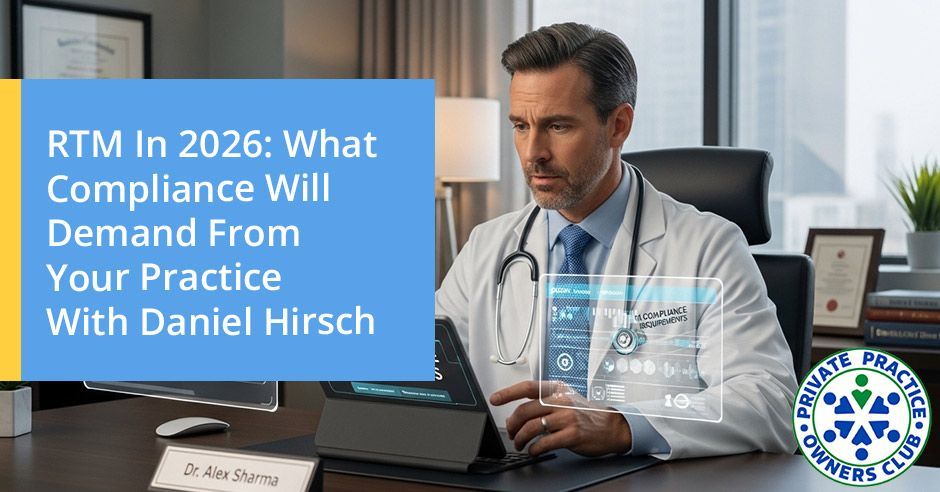
RTM In 2026: What Compliance Will Demand From Your Practice With Daniel Hirsch
Remote Therapeutic Monitoring (RTM) is no longer “the next big thing” — it’s here, it’s evolving fast, and in 2026, it’s becoming one of the most powerful levers for revenue growth, patient engagement, and long-term practice sustainability.
But with opportunity comes responsibility.
In this episode of the Private Practice Owners Podcast, host Adam Robin sits down with Daniel Hirsch, CEO of Risk & Compliance Analytics and one of the most trusted voices in compliance, to break down what RTM actually looks like in 2026 — and what compliance will demand from practice owners who want to do it right and keep the money they earn.
Daniel pulls back the curtain on why RTM struggled early on, how recent rule changes have made it far more flexible (and forgiving), and why the practices winning with RTM are the ones that treat it as a system — not a billing hack. Together, they reframe RTM as a tool for controlling time, improving outcomes, and increasing touchpoints with patients, not just another CPT code to chase.
They dive into:
- Why RTM adoption stalled early — and what changed heading into 2026
- How new payment rules reduce risk and reward consistency over perfection
- What compliance actually requires when billing RTM (and where practices slip up)
- Why documentation, timing, and patient communication still matter
- How RTM fits into an active plan of care — and where owners get in trouble
- The real financial upside of RTM when enrollment reaches scale
- How to think about staffing, vendors, and workflows without burning out your team
- Why Medicare’s continued investment in RTM signals where the industry is headed
This is a practical, no-hype conversation for practice owners who want to grow smarter — not riskier. If you’ve been sitting on the sidelines with RTM, worried about complexity, compliance, or whether it’s “worth it,” this episode delivers clarity, confidence, and a roadmap forward.
🎯 Takeaway: RTM in 2026 isn’t about being perfect — it’s about being intentional, compliant, and consistent.
Want to talk about how we can help you implement RTM the right way, strengthen compliance, and protect your revenue?
👉 Book a call with Nathan: https://calendly.com/ptoclub/discoverycall
Love the show? Subscribe, rate, review, and share: https://ptoclub.com/
---
Listen to the Podcast here
RTM In 2026: What Compliance Will Demand From Your Practice With Daniel Hirsch
Adam, what is going on?
Just another great day to be alive. Wake up every day with a couple of goals on your to-do list, and you just tackle them every day. Having a great day. What about you?
Checking boxes. That is it. That is what having a good day is about.
RTM’s Real Opportunity For Private Practices
The funnest part about the day is RTM. I do not know if you guys have heard about RTM. It is a big thing. It can make a big difference in your practice from a revenue perspective, not just from a revenue perspective, but from a patient engagement perspective, and patient compliance. We can get better outcomes.
There is a lot of research behind it. People have been slow to implement, but it is starting to gain traction. There are some compliance concerns. We have to check ourselves to make sure we are doing it the right way. That way, when we get paid, we can keep the money. We got Daniel Hirsch. The number one compliance guy on the internet. He is going to tell us all about RTM, remote therapeutic monitoring for private practices. Daniel, train us, man. Teach us what we need to know.
Thank you, Adam. Thanks again for having me. I want to start by saying you are totally right. RTM, remote therapeutic monitoring, is not a secret. It has been around for a while now. You probably know there are people who charge for this information, but in this setting, in the PT profession, we need fewer barriers. We do not need more toll collectors to access this information. If you are still paying for this, no excuse. We are on the clock.
In the PT profession, we need fewer barriers. We don’t need more toll collectors limiting access to this kind of information.
We are going to fly through this really fantastic topic, RTM. I love it. For PTs, this is year four. I am proud to say that I have been preaching jumping into RTM. It is finally gaining momentum. Also, if you notice, some of the loudest voices in at least my compliance arena, they only became interested once they had a financial incentive to do so. Take that for what it is worth. RTM 2026 looks very different from the 2022 version.
Thank goodness, the problem with the original rollout was like the kryptonite that affects most PTs, and that is math. I do not know if you experienced this, but we avoid it like it is the plague. Counting monitoring days over a 30-day period versus over a calendar month was just too much for the normal physical therapist. We could not handle it. I want to reframe RTM from what you probably heard to a new perspective.
There has been a lot of talk about RTM to help owners make a stronger decision for the growth of a company. Adam, I went back and reread some of my blogs and watched some of my webinars on RTM over the past couple of years. It was good content. It made sense. Practices were really limited by the poor technology. You need that to be able to bill for this. Think of it this way. When you control the clock, you are able to determine how your schedule looks, what services to include, or what to bill.
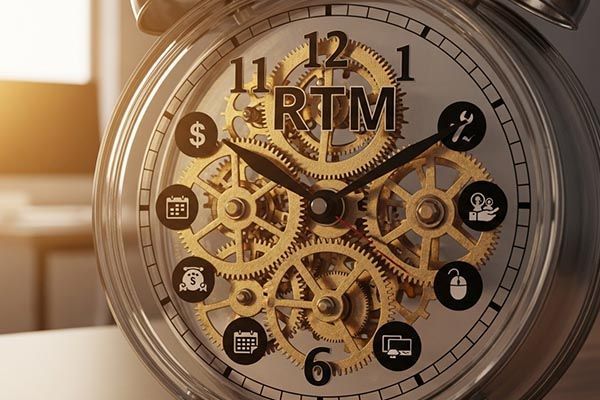
Also, you need to relax on vacation. All these important variables impact us in and outside of the clinic. What people need to understand is that RTM allows you to take back your time. You haven't really heard this from an RTM perspective, but I want people to understand that you decide when you send that email, that text, that electronic communication with the patient. You decide who will help you accomplish this on your team is really up to you.
I feel like the perspective needs to change. Maybe it is a staff member looking for extra work, or maybe it is a third-party vendor who will manage everything. It could be a hybrid approach, lots of ways, but ultimately, you need to decide how to control the time for the service. That is why RTM is very unique. We need to really accept this opportunity. It is a gift of clock management, in my opinion. As a coach, I am always telling people, you've got to control the clock. This is not hypothetical.
How RTM Works In Practice And Why 2026 Changes Everything
We also know that Medicare and other payers pay for this. It is a winning formula. You get better outcomes, better retention, and you get all those boxes that you want to check off. This does that for you. I am not saying it is the end all be all. It is not going to make all problems go away, but let me run you through what RTM includes. A few numbers from the 40,000-foot view, RTM has got to be supplied and provided by a qualified device, and the data needs to be transmitted.
RTM is a winning formula. You get better outcomes, better retention, and it checks all the boxes you’re looking for.
That is the whole concept of what this is. Basically, you need to onboard patients. You have to supply them with the device, and then you have to monitor and interpret the progress. This is like the 21st century version of like, remember the VHI stick figures that used to copy, and you would have to hand them out to your patients. I guess that is just me being old, binder that stuff, you have to go find half of them were missing, they were numbered. It was terrible.
This is just a really great version of that. I will give a shout-out. I listened to Stephen Cohen last week. He was at the Graham sessions, I think it was Jimmy McKay interviewing him or some live thing. He basically gave the idea that when you are explaining this to patients, at the onset, it just needs to be routine and part of the PT experience at your practice. Not everybody could participate. Not everyone is appropriate for every treatment option.
When you reframe the benefit as something that is simply necessary to succeed in therapy, that is really the goal. You have a couple of codes. There are not many. Most people are not billing all the codes. We are not respiratory therapists. Basically, you have a couple of codes. You have 98975. That is your setup. You have your 98977 for monitoring. 98980 and 81. Those are the first twenty minutes and then the second twenty minutes of data collection, monitoring, and interpretation.
Stop and think. You control this time of how and when. I guess this was complicated, and it had a really high threshold because you did not capture all sixteen data points within a certain component or the full twenty minutes, so you got nothing. People were kind of ticked off. It was an escalation of commitment, almost where you have to keep investing, and you are like, "I'm relying on someone else for that paycheck."
That is very hard to commit to. In 2026, you now get paid the same exact amount, which I think is fantastic, but you can receive payment if you only obtain 10 to 19 minutes or 2 to 15 days of data collection instead of the all-or-nothing I was talking about. That means you have more flexibility for not being perfect without really carrying the risk of wasting your time. A lot of vendors offer this. They offer creative solutions, integration, and really great things. Each one has a very distinct personality.
You should pick the one that really matches your company and what your culture is all about. Do not go out there and find the biggest. You need to find the one that fits basically how your staff interacts. This whole conversation is really Adam is about taking back control of your time. RTM is a very good answer for it.
Nowadays, you hear a lot of grievances about fee schedules and reimbursement rates, and reports about fatigue and burnout. I understand that, but if you put two and two together, this is a really smart route to take after you have been given a four-year runway. In my opinion, if you are finally starting, congratulations. If you are already doing it, you are probably taking a deep sigh and going, "This is fantastic that I could get more for not being perfect."

I am going to shout out to Stephen Cohen. He owns Cerah Health. He is a sponsor of the PPO club. I got to shout him out. He is also a really cool guy. Super passionate about this topic. Check them out. We actually use them as well. The thing that attracted me to RTM was, obviously, as a business owner, the financial opportunity. We are always measuring the revenue per visit.
How do we squeak that up an extra dollar or two here and there? When you step back, and you do the math, and you zoom out, it is like $40 or $50 per patient per month or something like that. When you step back and do the math and look at man, if we had 30 %or 40% enrolled in this, it makes a real financial difference when you extrapolate it over twelve months.
It is not a small number.
It is a legitimate number. It will offset a lot of expenses.
Even if you are giving a percentage off the top, even if you are outsourcing 100%, it is a very large number.
Financial Impact And Where Practices Commonly Get Stuck
It is some setup energy, some training involved, and obviously, you have to be actively involved in that process, but a lot of things are automated. As you mentioned, that math problem is solved for you with the use of technology now. It is easy to implement from my perspective. It is really cool because you can create bonus programs around that. I do not know if that gets into compliance issues or not, but I have heard of companies building bonus programs around RTM.
That is my limited, ignorant perspective of what RTM is from a business perspective. I would love to hear you tell me where you see people get in trouble. What do you feel might be important to make sure you get these one or two check boxes checked before you start charging people for it? What are some of the things that we need to have in mind from a compliance perspective?
A lot of the vendors, the tools that are available, do the math for you, and they basically prompt you. They tell you what to do. They are like, "Here you go." Where people run into trouble is a universal problem with specific insurances, where there is a copay or deductible. Sometimes you are paying. You are applying things to maybe the wrong date or a non-date visit, and then it is triggering something else. You have to use some thought.
You cannot just randomly start tagging codes because this is a different concept of how you capture billing. Usually, we are very physical. First thing is in front of you, you deliver the service, and then you bill a code. This is not. This is where you finally bank it, and then you apply it. You have to be thoughtful when you are doing this. This is again very rare, but from a documentation standpoint, you have to be able to retrieve that data into your EMR.
When there is a documentation request, it has to live somewhere that is secure, then eventually, if there is a request, you have to be able to extract that and put it into your documentation. It is not really a problem. You just have to be cognizant about that. You were alluding to this is a fantastic thing that we usually hear people complaining about, "How do I charge for reviewing a home exercise program?" This is literally the answer. When you're saying you want continuity of care.
By the way, they have to be actively participating in a plan of care. That is also one of the key components. You cannot discharge a patient and then be like, "Congratulations, you're doing RTM." It does not work that way. They have to be active. The idea is that RTM specifically, there could only be one, so you cannot have your snowbirds up in New Jersey do an RTM, and then they go down to Florida, and they are also doing an RTM. They cannot be simultaneous.
The idea is that it has to be that open plan of care that allows for the billing to take place. The idea is that you really want to make sure that they understand what is involved. You do not want people to be surprised. This is a classic compliance issue where you think you are communicating, but you are not communicating to the patient. As long as you're communicating clearly at the onset, it will absolutely pay dividends. I have seen companies do really well with this over the years.
As long as you’re communicating clearly at the onset, it will absolutely pay dividends.
Adoption Mindset, Patient Communication, And The Future Of RTM
There is real value there. That is important to understand.
Even conservatively, Adam, it is something like 150 per episode of care. Those are conservative numbers.
If you extrapolate that over twelve visits, I do not know what the math is, maybe $13 or whatever that is. I do not know. There is real value financially and also for the patient. Personally, when I think about it, I have a few businesses. The businesses that do well are usually the ones that have higher touch points with their customers. They are more actively involved and engaged at a higher frequency. They feel heard, they feel supported, and you catch little issues a little quicker. You're more responsive.
You're dialed in with the patient.
That usually increases the lifetime value of the patient. They refer people to you. There is real value there for the patient. They are going to get better outcomes, assuming that they actually utilize the service. They're probably going to get better outcomes. Medicare has done its research. They are not just rolling this out to see what happens. There is a reason why they are raising reimbursement rates, or they are making it easier to get paid this year, because it seems obvious they are moving in that direction, because they are seeing costs go down for them, or they see a future where costs might go down.
We know everyone is going to follow whatever Medicare does.
Healthcare, as well, is transformative. That is amazing.
You are not going to be looking back at this going, "You were right, why did we jump on this?" There is no reason not to. Usually, in the first twelve months, people are like, "It's the wild west." You do not know what is going on, but this is proven. We know it works. This is clearly where everyone else is going. It is a shame if you do not. You almost have to feel bad for people who are not jumping into it.

Just do it, man. It is a skill. Take a couple of Saturdays and Sundays off. Read, learn it, and then learn options.
There is no one right way. You've got to look at your staff and say, "What is my staff capable of doing?" You could figure that out.
This is episode 3 or 4. I cannot really remember. We are doing five action-packed fifteen-minute segments on compliance. Do not really remember what the next week's. Actually, we're taking a week off, but the next episode, I am not really sure what it is, but I know it is going to be good.
I forgot what it is. We will make it interesting.
If you're watching on the Facebook group, check out the comments. I am going to have some information about Daniel, what he does, and how he helps people. If you're tuning in to the podcast, check out the show notes. All that information is there, too. Daniel, where can they find you?
At RiskAndComplianceAnalysis.com on our website. It is very easy. We have everything from a compliance perspective. When it comes to outpatient PT, we thought of everything.
Sounds good, man. We'll see you next week.
Thanks, Adam.
Important Links
- Daniel Hirsch on LinkedIn
- Risk & Compliance Analysis
- Risk & Compliance Analysis on LinkedIn
- Book a call with Nathan