
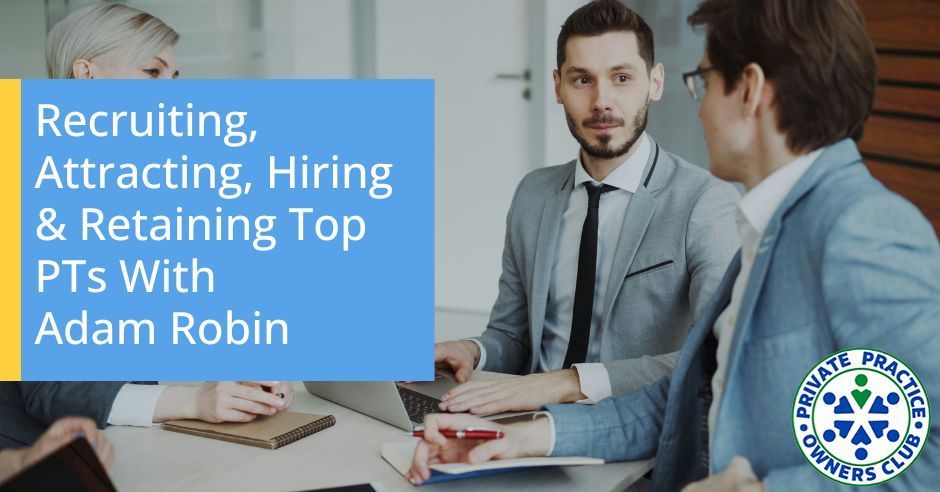
Recruiting, Attracting, Hiring & Retaining Top PTs With Adam Robin
Most private practice owners think recruiting is about posting a job ad and hoping the right clinician applies. That strategy isn't working anymore.
In this live discussion, Adam Robin and Nathan Shields pull back the curtain on what actually drives successful recruiting in today's market—and why the clinics that consistently attract great clinicians are operating from an entirely different playbook. Adam shares how his team experienced two resignations in the same week yet had interview opportunities lined up within 24 hours. The secret wasn't luck—it was having a recruiting engine already running in the background. Together, Adam and Nathan break down the systems, mindset, and marketing principles that allow practice owners to consistently attract talent, create compelling opportunities, and build teams that support long-term growth and freedom.
In this episode, you'll learn:
✅ Why recruiting is really a marketing problem
✅ The biggest mistake owners make when trying to hire clinicians
✅ How to build an Ideal Candidate Profile (ICP)
✅ Why most job ads fail to attract quality candidates
✅ The concept of a "Grand Slam Offer" and how it improves hiring success
✅ How to create recruiting assets that work around the clock
✅ The role AI, automation, and VAs can play in your recruiting system
✅ Why speed is one of the most overlooked recruiting advantages
✅ How to create a recruiting flywheel that generates opportunities year-round
✅ What practice owners can learn from high-performing recruiting organizations
Whether you're struggling to fill an open position, preparing for future growth, or simply tired of feeling stuck whenever someone resigns, this conversation provides a practical framework for building a recruiting process that actually works.
Recruiting isn't something you turn on when someone quits—it's a system you build before you need it.
Want to see exactly how Adam built his recruiting engine?
Join us for the Pre-Conference Recruiting Workshop where Adam will walk through his CRM, outreach systems, AI workflows, recruiting assets, follow-up sequences, and hiring process step-by-step.
PPO Club Conference 2026
The High-Performance Practice: Balancing Purpose, Profit & Freedom
Join practice owners from around the country in San Antonio as we tackle leadership, recruiting, operations, profitability, and growth.
Love the show? Subscribe, rate, review, and share with another practice owner.
99.5% of successful owners interviewed on this podcast have leveraged a business coach at some point in their journey. Private Practice Owners Club is the coach you need to build a practice that delivers profit, freedom, and purpose.
---
Listen to the Podcast here
Welcome to the live, everyone. We are going to talk about Nathan's favorite topic, which is recruiting.
It never ends when I am talking to people. It is like issue number one all the time at the top.
I know.
Is it like that for you and in your clinics?
We had two resignations this week. We are back on the ground.
Were you fully staffed at that point prior to the resignation?
One was okay because we were a little bit heavy. It was like, “I want a raise.” I was like, “You are not full yet. We've got to get you full first.” She is like, “I quit.” I was like, “That makes it easy on us then.
It actually makes it easier. Thank you.
That makes it a win-win. It is great for us because now we get to be more profitable. That is not a big deal.
It is not actually a speech therapist.
I heard a little bit more, but also somebody whom I value a lot. The speech therapist was awesome, but not quite the A-player we need there. Even though it is a bummer for the team and for me personally, I think it was probably the better thing long-term. It will make us a better team. We have an opportunity to bring on somebody who is a little bit more aligned. This is not about me, but nevertheless, good news, within 24 hours, I had two interviews for speech therapists.
How does that happen?
Man, I think I am good at this.
Creating A Sustainable Recruiting Engine
You have a recruiting engine now that is whirling and going, even though you have not been hiring for the last few months. When you need somebody, it does not take a lot of energy for that engine to push out some resumes. You have got a flywheel that initially was a ton of effort to get going, but now it just takes a little bit of effort to keep it twisting.
Especially with AI now, it is like a lot of it is copy and paste, a lot of it is automated. We already have the lists of PT's built. We already have all of the demographic information and the contact information. We have the CRM set up. As you said, it is really just like, “How do I get the message out to everyone quickly and in every capacity that I can?” With technology now, it is easier to do that.
If you send it on the spigot.
If you just send, it is like, “I am going to send 1,500 emails and 1,500 text messages and see what bites.” The thing is that people are always dipping in and out of that transition window, that buying window, if you will. “Summer is here, maybe I would like to spend more time with the kids. Maybe I do not want to do this corporate thing anymore. Maybe I want to get back on the treatment floor.”
Those things happen periodically throughout the year, but those windows are very tight. They are like ten days, and then they get back in their routine. You've got to get in there, you've got to get inside of that conversation, not that you are trying to trick them into working with you, but you are trying to see if maybe there is an opportunity for you to create something better together.
Get into the conversation—not to convince someone to work with you, but to discover whether you can create something better together.
Let us do this right now. I want to share my screen. Go for it because you are going to talk all about this. At our pre-conference workshop, so that people can learn how to do exactly what you are doing. I am going to put this link for our conference in the comments, so people can get on the waitlist. Registration should be coming out this week, and the pre-conference workshop is all about exactly what you are talking about. The CRM, all your systems, how you do things, what does your recruiting engine look like? If people go to the conference page when it comes out, they are going to get an opportunity to sign up for the pre-conference workshop.
We are going to spend, I think, we have five hours planned, where you are going to open up your computer, show exactly how you set everything up. The social media leverage that you use, the emails that you send, the text systems, and your CRMs, so people can learn all about how you do things if they go to the pre-conference workshop. It will be available both in-person and virtually, so you do not have to be there. It will be that five-hour block available to you, even from the comfort of your own home, if you want to join us for the conference afterwards on Friday and Saturday. That is well.
Which I recommend. Highly recommend. Highly encourage.
Highly recommended. Highly encourage, if you are an owner, to join us. Not only if you have a recruiting issue, but if you are an owner, we are going to talk about how to be a better owner, basically, how to get more profit and have more freedom and purpose in your life. I will share this, as I said in the comments, so that people can go here and learn all about how you set up your recruiting system. When someone quits, like you did this week, you can turn on the spigot and have two interviews a couple of days later.
A couple of things to keep in mind about this workshop, and just learning how to recruit in general. There are so many reasons why you should learn this skill. There are so many reasons why, even if you do not want to recruit, you should still learn how to do it and what it is. You need to orient yourself to what good recruiting skills look like and what the standards are.
It is like you were going to hire an outsourced builder. If you were going to hire an outsourced recruiter, you would want to know, “What is your strategy? How do you dial in your messaging? What is your outbound cadence? What does your follow-up cadence look like? Where do you post your job ads? How do you qualify and disqualify job ads?”
All of those things are really important for you to learn because they are valuable skills, first of all, to be a business owner. If you do want to become your own recruiter, great, now you have a really great orientation and framework to hold some type of outsourced solution accountable. You can create a line around what good work actually looks like.
What can you expect?
Correct. The other thing is, if you want to train somebody on your team to do it, or maybe you can just own pieces of it. Maybe there is a really hungry clinician who wants an opportunity for leadership in your company, or a really great front desk person who is good with social media and AI. You could create a small recruiting division in your company, a valuable skill that I highly recommend you learn. Whether you want to learn how to recruit, market, or promote your stuff in any capacity, I think you will walk away with some value. You will be able to make better decisions and make a bigger impact in your recruiting division next year.
I can look at your experience over the past few years, and it is your growth capability to withstand changes like this. Your ability to expand and develop leaders has been directly tied to your ability to recruit.
I think so. Listen, there are a lot of people. If we run your audit through my practice, you are probably going to be like, “Adam, you are missing a bunch of money.” It is not perfect. I am not here to tell anybody that what we do is perfect in any way. There are tons of problems, but I think what I do have is I do have an ability to keep good people on the team and build them up into leaders, and it gives me my freedom. My practices are wildly profitable, like most in-network practices are not, but we are profitable, and we understand our margin. I get to hang out in my house all the time with my kids all summer. I like that stuff. It is pretty cool. Having really strong people and systems in your company is critical to creating that time for you.
You hit on something, and we talked about it a few months ago in the show, that one part of recruiting. Maybe tell me if you want to start here or not, or if you want to start more basic, but one part of recruiting is retaining the right people. Do you want to start a conversation there, or do you want to go back to more basic stuff regarding what people did not need to know about recruiting?
That is a really great topic, the subject to tap into. Whenever I am looking at the Facebook group, the survey that we put out, which was ridiculous, I do not think many practice owners are having a really hard time with retention. It is hard, but it feels like the biggest hurdle is how to generate opportunities. How do I generate interview opportunities, which is where the biggest constraint seems to be, and then which leads to the second biggest constraint, which is, “I have got a few opportunities, how do I deliver some type of offer that converts, that gets people to actually enroll into your company?” The third constraint is probably that retention piece. If you do not mind, I would love to start on that front-end.

If that worked. Yeah, I could see where you are talking about most people. If you are talking about their pain spot is like, “How do I get in front of these people?” Maybe it does go before that, like being clear on what you are selling.
Defining Your Ideal Candidate Profile
They all work together. They are segmented. There is like a lead generation, a conversion, and a retention piece, just like any funnel or business works, but they are meshed, like one cannot work without the other, and they all build on top of each other. There are really two things that are foundational to this entire process that are critical, that you must do the boring work around, which is number one, defining your ideal candidate profile, your ICP. At the end of the day, what you are trying to do is target a specific human, a specific type of human who aligns with you in some capacity and has some demographic characteristics like a personality profile that aligns with your culture.
They have some skills. They have some type of work history that qualifies them, they live, and also, there may be at a certain point in their career, like if you are looking for a leader or if you are looking for a new grad, that is going to be different. They are going to have a very specific pain point or need or desire that they are trying to fill. It could be somebody who is burnout or somebody who is underpaid, or somebody who feels overwhelmed in their career. Maybe it is a new grad that landed their first job, and they are like, “I really regret that job.”
Getting clear on these things will help you build an ideal client profile that will define who you are talking to, exactly what their pain point is. Which will result in how are you going to help them solve that pain point, how are you going to formulate an offer that directly solves that? What outbound messaging are you going to use to speak clearly to that person around that pain point and around that offer? Otherwise, if you do not build that out, I do not know if you guys are fishermen. I am not, but I know how it works. You go out there. You might be fishing in the wrong pond, you know what I mean?
You've got to know what you are fishing for and your bait.
If you want to go out there and you want to catch a marlin, and you are in a freshwater pond, you are in the wrong pond. You are just spraying and praying. The market will dilute your message, you will not stand out, nobody is going to notice you, and they are not going to create that magnet of awareness for the right person without something.
It was easier for us to figure that out over time after we tried and burned through and turned a few providers. A little bit harder if you are on your first or second provider that you are trying to hire. If you have been through it quite a bit, you can say, these are the type of people that, number one, do really well in our company. Let us just explain who they are, what they like, and what their personality type is like. It is easy to figure that out.
Who has stuck around and done really well and seems like a great fit. It does not have to be like magical picking it out of thin air. You just look at the people who do really well for you and describe them. For those people who have not gone through that process, you just have to think about someone who is going to align with you because you are going to be working with them quite a bit in those beginning stages.
There does need to be some personal alignment to your values, your personality type, and the way you work and the way you do things. Not to say that they have to be an exact replica of you, because complementary people are very helpful in those stages. You have to have some of your own personality type testing done to know who works well with your personality type. If you can use the "What is the genius format?
Seven working, six working geniuses.
You can use the Enneagram and plug your scores into some AI, and it will tell you who would be complementary and work well with you. As you do some of these personality tests, you will know who will complement you. Now you can tailor your pitch or your ad to those people who would complement you. There are ways to do it, and you do not necessarily have to pick it out of thin air.
No. It should be structured. It is not like that. Otherwise, we get your kid to write you up something.
That is what people do. People might just say, “If they are going to use AI, let us just use AI. “Write me an ad for a prior that I need 40 hours a week, and I am going to pay them within this range of money.” You need to do a little bit more work than just let AI handle everything.
Name one thing in business that does not get massively better if you do more quality work on the front end, onboarding, training, retaining, and money. All the value is in that front in boring work. I think going really deep and intentional and specific and targeted and strong quality, you can mess up on the back end, but you want to get that stuff right.
Get that avatar really nailed down. Do you happen to have a name for your idea?
I do not.
I remember Will putting people through his program. He would say, “Give him a name.” David or Betty, or someone like that. That way, when you sit down with the rest of the team, they are like, “We are looking for our next David, and everyone totally understands what you are talking about.”
As I hear you speaking through that, I think there are two pieces that need to interlock here. One is going to be the problem that they have with the candidate. They want to make more money. They want more freedom. They want more autonomy. They want more independence. They want to move to Alaska. Whatever that specific problem is, you've got to get clear on that because you want your offer. That is going to be the thing that attracts them, that really brings them in. That is the bait.
It might be the wrong personality, but like, if you are not speaking to them, you have got to make it about them first, and then you can make it about you once you have them on the interview or once you get them on the phone. You can qualify them. If you qualify them too hard on the front end, you are going to get ghosted a lot. I would recommend it is kind of like you want to hold the hot dog out there, get them in, and then qualify them with the personality and the other things.
In practice, would you say the way that you do that is so that your subject line or headline is more speaking to them than the body?
It is the hook.
The hook is what you are talking about.
The hook is around their pain or what they want, something that taps into their emotional profile. That is going to entice them to read the job, and that is what you need to capture them.
The best hook speaks to people's pain or what they truly want. When you connect with their emotions, you capture their attention.
They actually browse down into the body of your ad.
We went on a little bit of a tangent, but that is really the main ideal client profile, which is huge, which goes into the second body, which is going to be your offer. I am a big fan of Alex Hormozi, but he calls it the Grand Slam offer. You want to make an offer that feels, in his words, stupid to say no to. A really great offer is going to be one that, if you were just like, we are a physical therapy clinic that offers physical therapy. It is great, but what else, like who cares?
It is very vanilla. From every ad that I see.
Constructing A Grand Slam Offer
If you do work with the right type of person, they can help you extract value from your practice, that is, like, “We are the company that helps people move to Alaska,” or "We are the company that helps you go fish salmon in the rivers in Alaska.” If you are speaking directly, because people want that. Maybe you are a very clinical-based practice, and it is like you are looking for somebody who wants a hand certification. “Do you want to? We are the company that helps you get certified and meet that dream of yours as a clinician?”
We want a tailor-made offer. It is still the same offer, still the same pay. You are just calling it something different. Building out a grand slam offer that speaks directly to that person and that maximizes the value equation not for you, but for them. If I can remember this correctly, the value equation is going to be a formula, it is going to be a dream outcome, multiplied by ease, divided by effort, and divided by perceived likelihood of failure or something like that.
Whatever that number is, the less it gets, the less effort. What does not totally exponentially increase the value perceived?
If you can imagine, the ideal offer would be a very specific outcome. That is their ideal outcome. That is extremely easy to achieve with you, and you have a proven history of success helping people achieve this outcome via testimonials and all the things, documents, and mentorship program, did it, all the things in a very short timeframe. Very little effort. We will fly you up for free. We will move you to a little. We will put you up in a cabin for free. We will pay your first six months of rent to help you move to a lot, or whatever. If you can do that, you have got a specific ideal client with a grand slam offer. You are going to get a few people to raise their hands.
For sure.
Makes sense?
Yes, totally.
Everything else downstream becomes exponentially easier.
It is a lot easier to go through what you are talking about. It takes effort to get through the stuff, and the effort is like, how do I sell myself on this clinic? How do I sell myself on this job offer? If you are not sold on the offer itself, it is going to be really hard for you to sell it to someone else.
One of the ways to extract that is, like, why would people want to work here? Most of us tend to underestimate the value that we do bring. I do not know if you remember, as a physical therapist, how you kind of have that imposter syndrome, and you have got these patients come here with shoulder pain, and you are like, “I do not need them to come in to tell them to do this with their arm with a band.” We downplay what we do know and the value that we do bring.
Definitely downplay our expertise, and we have got the value of what we have for sure.
Same with a practice. Maybe you have been in business for twenty years, and you have stability, and you have mentorship programs, and you have a specific niche, and you have strong referral partners, and you are in a great location, and you have a beautiful facility, maybe you have a special piece of equipment. AI scribe, you have got a great EMR, like there are a lot of things that you are doing well. It is just really about extracting that so you can put it into some language that people can get excited about.
We have that tendency to downplay it like, "My facility is nice, but I know I need to do some touch-up paint over here and over here.” I know that piece of equipment is about twenty years old, but it still does a really good job, and I do not want to get rid of it, but it is old. I do not want to tell anybody, and you have all these monsters in the background in your internal dialogue that tell you, “No, it is not that great.” You have to get past that and see it for what it is, and really present that out to the potential clients.
See what fish will bite. If they bite, let's put some ads behind that sucker. If they do not, let's go back to the drawing board because they have a value equation. When you do that well, what you can do from there is you can start building assets. Especially with AI now, it is so easy. You can build compelling job ads, you can write email scripts, text message scripts, and DM scripts.

You can make social media graphics and social media posts. There is a lot of context there for you to build really meaningful assets to attract your people, and then you can deploy them into the marketplace at volume. When I say volume, I mean a lot all the time everywhere, more than you feel like is appropriate, and you will get hooks, you will get people that bite.
When you talk about assets, you're not only talking about the content that you create, you're also talking about, “I am going to start developing my connections network on LinkedIn, my connections on Facebook, and I am going to have a lot of professional connections.” Meaning a lot of professional emails. I am going to get whatever I can in terms of contact information from the state board of physical therapy, occupational wherever you're at, or speech therapy to get the contact information of the licensees in the state.
Those are all assets that you start with. You cannot do anything if you do not have those assets. You really own nothing if you're just posting an ad on Indeed. What you're talking about is a much grander scale, like let's build this system, these parts of the engine that pertain to social media assets, content assets, email assets, text assets. Now you really have some power to get your message out.
It is a tackle box. You got different wheels, and I can get some AI going on. You got some armor.
You got all kinds of stuff in there.
If you show up and you're like, how do I get a PT to like me and you do not do that word, like it is going to be hard for you to attack the marketplace and be competitive and stand out.
What does it take for someone to build up those assets on a consistent basis? Maybe they could spend 40 hours a week, but really, that is not going to be effective.
It is going to be a system that you have to build. I am one of the weird PTs who fell in love with recruiting. I do not know what it is. I just fell in love with it. It is not hard for me because I love it, but most people hate it. Most people do not want to do this. They want to treat patients.
They do not want to be on social media, bugging people, which can be salesy.
That is fine. You can create a faceless one, like a founder is not the face of the recruiting engine. You can do that. It is going to be less effective because the founder-led recruiting is always going to be higher converting.
Have you found some VA's that'll tackle this and do well for you?
Totally. That is basically what I do.
Your VA's you'd like you to give them the system, and they run it under your name.
Give them the system. We have an interview or a formal screening process to really clarify the ideal client, really clarify the grand slam offer, and maximize the value equation. We use cloud and cloud code, and all the AI tools to build all the digital assets. It is just very quick. It took five years to build that
You can build all that stuff, but your VA's or you need to be spending at least a couple of hours a week, would you say? Building those assets, connecting with people on LinkedIn, especially, I am assuming, maybe Facebook, stocking that stuff.
Deploying Volume With The Rule Of 100
The next system is going to be, “Now that I have all these assets, how do I actually deploy them. How do I deploy it? How do I deploy that volume? We run what we call stealing a lot of this from Alex Formozzi, but we call it the rule of 100. It is a 100-day sprint. We do 100 outreach a day for 100 days. We try to do some geotargeting for clinicians who are within 20 miles, within 60 miles, and within 100 miles. We go after that local community pool to let everyone know, “We're recruiting. We have a very unique offer with a very valuable, unique value proposition. It is worth being considered.”
It is super valuable. I remember one of our clients, if you recall, she was in a small rural town in Idaho. She started doing some of this work on LinkedIn. She's like, “How am I going to find a clinic director to move to this small little town in Idaho?” She got on LinkedIn. She started connecting with people and found people who were close by. Connected with one person who was literally just a few miles away in another clinic, and did not see a path to leadership in that clinic.
They connected on LinkedIn, and she's like, “I never would have reached out to her before because she'd been at that clinic for so long.” She was like a foundational piece of that clinic. She was unhappy because she did not have any growth opportunities and brought her over, like fulfilling all her dreams. Nicole, the owner, likes that not all of them are going to turn out like that, but some of them will. It is not uncommon that people start reaching out to you on LinkedIn as you start making some of these connections.
You've got to reach out because the market is unpredictable. It is predictable, but it is like the stock market. It is like it is going to go up. You've got to stay consistent, because listen, if you go out and you tackle LinkedIn during a downward market trend, it is going to crush you. You're going to send 100 DMs a day for 50 days, and you're going to be like, “I have got nothing.” If you just waited another two weeks, all the new graduates would have graduated, and boom, you would have started getting them.
All that to say, you can do this at a small scale if you have one or two clinicians to hire, but if you want to have a strong recruiting system that lasts forever, you have to be able to maintain a certain level of volume consistently for a long time. It cannot occupy all of your bandwidth and energy. You have to find ways to leverage assistance or team members or recruiters or somebody to help offload you so that you can just own the vision and not all the heavy lifting of that.
A recruiting system only lasts if it's sustainable. Build one that runs consistently without consuming all your time, and delegate the execution so you can focus on the vision.
That is where, for me, that is where I would have to have a VA that is doing this work for me. I can speak for a number of small business owners who just get distracted by the shiny thing, and once they find the provider, then boom, everything gets turned off. Knowing you, you're doing a little bit, you're dripping into that system, or at least your VA's are doing a little bit of effort consistently, even when you're not hiring.
Totally. The owner, just to be clear, this is not even if you did decide to get a VA. It is a great idea, but you still have to own it. You are the CEO of the company.
It is possible for you.
You expect most of the people in the group, or you want solo practice owners, maybe two locations. Unless you have a director of recruiting who you're paying $100,000 a year who can own this for you, you have to be the person who's promoting the company. You have to own that messaging, you have to own that vision, you have to own driving those outcomes. You have to. Just like you will promote to the community and promote to your referral partner, you have to. There is another funnel on the other side of your company, called a talent acquisition funnel. How do I bring clinicians into my practice consistently and help them solve their unique problems, just like I do with my patients? It is like you just have to figure out how to solve that problem.
You said you do not have a director of recruiting that you pay $100,000 a year to, but that is who you're going up against. If you're fighting against companies that have $100,000, you're recruiting departments that are recruiting, and you have to be doing something to counteract that. Now you do not have to have that salaried recruiter, but you need to be doing something consistently because your message is valuable, and that is what you're going up against. What they're doing is they're consistently doing the work full-time, meaning when someone pops up and says, “I am not satisfied with my current situation, they're always there. They're always skimming that surface.”
Whereas if you only pop your head up once there is a need, you're just taking a chance that they're coming up out of the water at the same time that you are, and that your eyes meet. You need to be skimming the surface, looking for people who raise their hand and say, “I am looking for a different situation so that you're available and put yourself in front of them.” They can compare against those large outfits that have recruiting departments.
The thing is, I do not want to speak poorly of those larger recruiting companies, but they're not very good.
They're not very good because the only thing they have to sell is a better salary.
They're not great at recruiting, though.
They're just recruiting because they can just outpay other people.
Correct. They can outprice you, yes, but you can outoffer them and you can outquality them easily. The bar is not that low, not that high, like it is not as high as you think.
Just a little bit of people who are burned out at the highest salary position.
Listen, I had a woman, a speech therapist who is a corporate regional director for a company. She's probably getting paid $130,000 a year. She wants to come work for me. She's burnt out, tired, and wants to get back on the treatment floor. People are willing to take pay cuts. She knows exactly what she's going to get paid working for me.
Situation's changed for people. It is not all about the money.
It is like there are always going to be those unique opportunities. They're not as unique or random as you might think. For instance, the woman who was in Idaho was like that person was right there. Those opportunities happen. What they say, “Look, find the people that go looking for it.” You can definitely outdo people. The truth is that I had a position available for this person that she could not get with her current employer. She bit the bait, and now we have an interview schedule next week. Will she take it? I do not know. We'll see.
Getting those leads is not the issue for you.
No.
Now it is a different skill set on finding out what they truly want and see if you can match up with it, and maybe more importantly, making sure they are aligning with you.
Coming back to the offer, there is an enrollment process during the interview. We call it the enrollment interview. It is important, in my opinion, to break free of the traditional corporate stale interview process, like tell me your biggest weakness, tell me like that interrogation that we all went through for our first job. It is not about that anymore, in my opinion, people have options. It takes a little bit of leadership.

Are you going to talk about how to do better interviews in that pre-conference workshop? We'll give them a sales framework, some scripts, and whatnot.
Some sales frameworks.
That is something that we're not trained on. No one's really trained on. You could get some training, but it is more along the lines of the corporate interview interrogation. That is much of the discussion.
It is a discussion about how I can serve this person. Using the assets that I have, I have a team, I have a little bit of money, I've got resources, I've got connections, I've got vendors, how can I pull together something really creative? That will maximize the things that are important to this person, other than money. How do I just hoard the gasoline on top of that? In a way that they're willing to sacrifice this for all of this other value. For all of this other value. Part of that interview process is really just understanding what is really important to them, what's truly important to them. If you can clarify that and get them to be like, “That is exactly what I want.”
“That is what I am looking for.”
You can be like, “What if I did this, would that be something you'd entertain?” They're going to probably say, yes, assuming that they're aligned with you. You might have to be creative. You might have to be creative, and that might mean that the offer might just be an opportunity. It does not have to be in the form of compensation. It could be a one-on-one meeting with you every week as a mentor. It could be something along those lines, and that could be individually established with every person on your team. It does not have to be this blanket compensation package. That is how you convert at a higher level there.
As we're wrapping this up, I think one thing needs to be said, and I know you have this, but it is just second nature for you guys, but speed is super important throughout this whole thing. You cannot have people DM you in responses and wait three days to respond back to them. You need to be on top of these things. If you're able to connect with them, get them in for an interview as soon as possible. You've got to move this process along fast. There is urgency behind this if you're going to catch them at the right time.
Maintaining Speed And Urgency In Conversion
I'd say speed is a tremendous component. Being available with speed and personalization is probably the best combination to nurture leads well. If you get a DM and they're like, "Yes, I'd love to have a conversation." It is like a voice memo. Book a call today. Book a call today. We need to have that level of urgency behind things. I would say that I am in this discovery phase, where I am trying to figure out what I am good at. I would say that one of the reasons why I've had some success with recruiting is just my relentless urgency around things. I just operate at a speed that a lot of people do not understand. If you just do that with recruiting or if you find someone on your team who's got that urgency, who's got that restless personality trait, you can convert candidates at a higher level too.
One of the biggest reasons I've succeeded in recruiting is urgency. Move quickly, and you'll convert more candidates than those who hesitate.
Good stuff, man. We're going to talk about a lot of this stuff on the pre-conference workshop, where Adam's going to pull back the curtains and show you exactly what he's talking about when he's talking about all these systems and processes and scripts and whatnot, how he leverages as a VA, etc. Check that out. I posted it on Facebook Live, but just to stay here for those who are tuning in, you can go to PPOClubEvents.com, where you can learn more about the pre-conference workshop and the conference itself. We'd love to have you at both. There is a ton of value. That is in October of 2026 in San Antonio.
I cannot wait.
Any parting words?
I am rooting for you guys.
It takes consistent effort. You've got to consider this a marketing strategy. Any successful marketing strategy is based on consistency and effort, and it is the same thing with recruiting. Recruiting is another word for marketing.
You can do it. If you need any help, just reach out. Shoot me a DM. I’m happy to help.
Sounds good. Thanks, Adam.
All right, guys. See you.
Important Links
- 2025 PPO Club Conference
- Private Practice Owners Club Facebook Group
- PPO Club Events
- Private Practice Owners Club