
Passionate about finding the alignment between humans and healthcare. Two-time start-up founder, focused on providing Private PT Practices the platform and playbook to solve runaway MSK costs for self-insured employers.
Automation That Maximizes Front Desk Efficiency with Ryan Klepps of SecondDoor
Nathan Shields • November 10, 2026
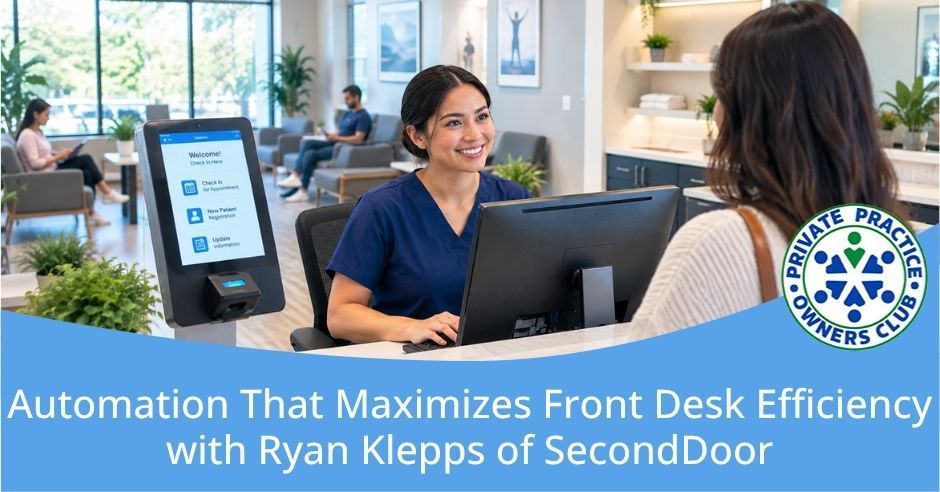
Your practice may already have enough demand to fill your schedule. The problem may be that your front desk simply isn't able to capture, convert, and schedule it fast enough.
In this episode of the Private Practice Owners Club, Nathan Shields sits down with Ryan KPS, COO and co-founder of Second Door Health, to explore how automation and AI are changing the way private practices handle leads, scheduling, phone calls, referrals, and front-desk operations.
They break down how practices can capture more demand, reduce manual work, improve conversion rates, optimize payer mix, and give their front office team more time to focus on the patients actually standing in front of them.
In this episode, you'll learn:
- Why practices may already have more patient demand than they realize
- How missed referrals can leave valuable patients sitting in a fax queue
- Why front-office processes are still heavily dependent on manual work
- How automation can capture leads from fax, web, and phone
- How AI can identify and process new patient referrals
- Why lead capture is only the first step
- How automation can improve lead conversion and scheduling
- How self-scheduling can make the patient experience more convenient
- How practices can create rules around evaluation scheduling
- Why payer mix optimization can increase net revenue per visit
- How better case mix can give practices more leverage with low-paying payers
- How AI agents can answer calls and help schedule new patients
- Why convenience is becoming increasingly important in healthcare
- How automation can allow front-desk staff to spend more time with patients
- How integrating automation with the EMR can eliminate unnecessary manual steps
- Why tracking lead-to-schedule and schedule-to-attendance conversion rates matters
- How practice owners can identify which front-desk employees are most effective at converting leads
- How better reporting can lead to faster training and operational decisions
- How automation can reduce front-office costs while increasing capacity
- Where AI and automation could improve scheduling, cancellations, waitlists, and insurance verification
Automation isn't about replacing the human experience. It's about removing repetitive work so your team can spend more time doing the work that actually requires a human.
If you're a private practice owner looking to improve front-desk efficiency, capture more patients, and turn existing demand into more revenue, this episode is for you.
---
Listen to the Podcast here
Automation That Maximizes Front Desk Efficiency with Ryan Klepps of SecondDoor
A quick heads up for all the private practice owners who are reading. If you've been tuning in to the show for a while, you know that it took me at least ten years of grinding in my own clinics before I finally figured out how to scale and sell my 4 practices for 7 figures, and about 3 times the national average. The biggest shift wasn't some secret marketing hack. It was how I thought about profit, systems and my role as the owner. That's exactly what we're going to be working on together with you at the High-Performance Practice Conference in San Antonio, Texas from October 15th-17th.
Adam Robin and I are hosting a three-day hands-on event for PT, OT, speech, mental health, peds, pelvic floor, and medical practice owners who want to build clinics that are profitable, scalable, and best of all, don't depend on them 24/7. We’ll dig into simple profit and KPI frameworks, real leadership and culture work and practical systems you can take home and plug in with your team.
If you're doing roughly 6 to 7 low figures a year and you want your client to feel more like a real business and less like a job/cage, I'd love to see you there. Frankly, I'd love to see you bring your leadership teams as well because we will have breakout sessions for them, too. You can get all the details and grab your seat at the link. Let's get into our episode.
---
I've got a returning guest. It's been a few years. I've got Ryan Klepps, the COO and Co-founder of Second Door Health. We talked a few years ago about direct-to-employer contracts and whatnot, but Second Door does a lot more than that. We'll get into it a little bit because I'm excited about what you guys are doing. Thanks for joining me again.
Thanks for having me on. It's always a pleasure.
I know you guys at Second Door came in to help out owners develop some of these direct-to-employer contracts. Since I did the episode with you, that's what I knew you guys for. I saw your booths at PPS and whatnot. What brought me to bring you on again is I have a client in our group who brought you on. He had brought on Second Door to capture calls that were coming in over the weekend, wanting to set up his new patients.
Stopping The Weekend Lead Leak
He found that with his team, they were calling these patients back on Monday morning, and they were losing 75% or 80% of those people because they were too late in calling back or X, Y, and Z. You name it. Implementing Second Door’s software, on the first weekend, he said, “They captured 5 or 7 new patients,” whatever it was. These people are calling on Sunday nights at 7:00. With your system, they can get set up. All the demographics are in the system automatically, and they're scheduled out. They show up Monday, and there are new people on the schedule.
That blew my mind. I think that's so cool. I wanted to get into some of the automations that are out there to improve the efficiencies at the front desk. I don't know if you want to start there and talk about that a little bit or how long that's been around, but I want to talk about some of these automations that are making the front desk more efficient and taking the load off of them so they can do more.
Starting off with direct-to-employer and then front office, what's the tie-in?
There is a bridge you can create there. How did that happen?
Don't let weekend patient inquiries wait until Monday morning. Automated booking captures demand before patients look elsewhere.
The general North Star is the same, which is that physical therapy doesn't get paid relative to the value we provide in the healthcare ecosystem. Margins are tight, and profitability is a problem. We still believe the long-term pathway is alternative payment models. We still spend a lot of time on direct-to-employer. The thing, though, is we worked with more and more practices. There are very short-term things that folks could implement through automation and the like that can influence their profitability. We see a lot of that being on the front office side of the house.
There's been a lot of innovation clinically. There's been a decent amount of innovation on the billing side. A lot of people are running their front office on sticky notes, spreadsheets, email inboxes, and manual processes. Streamlining that and then also being more thoughtful about how you convert demand could have a meaningful impact on profitability. It came down to, “If Scott and I were running a practice, what would our playbook be?” Scott is also a PT. It would be like, “Get as profitable as you can in the short-term and then open up alternative payment models down the line that take longer.” We were like, “Let's go do that.”
I like how you connected those two things. We can work along the path of the patient experience. Should we work that way? Would it be easier to explain some of the automations that are in play for practices to make these front desk people more efficient and not rely upon the person to follow the system, but the system is automatically working through robotic automations?
Centralizing Inbound Referral Channels
Typically, demand to practice comes from three channels. It comes from fax, the web, and the phone. If those are the three channels, one, how do you centralize those things? A lot of practices have those all managed in different silos. A standard practice has website inquiries hitting email. They have eFax going into a queue in their EMR.
They've got people picking up the phone and answering it. They're putting everything into a single spreadsheet and trying to manage through that spreadsheet. It's hodgepodge. When you're thinking about the automations you can put in place, it's going to be different depending on the channel. For fax, fax is here to stay. The vast majority of practices, their number one referral source is still fax.
If they are insurance-based and dependent upon referrals.
It's super highly manual. Technology has come a very long way where there's optical character recognition as well as AI that you can train to be able to look at a PDF and be deterministic. You look at it and say, “Is this a plan of care? Is this a request for information? Is this an authorization, or is it a new patient referral? If you identify a new patient referral, how does that get put into your lead management queue to be worked and pull whatever information you can off of that? That is the idea because it's sitting in a queue. You have to go from top to bottom to try to figure out which ones are which.
The short of it is that lead capture is the first step that you're thinking about automating. For fax, it's literally getting the PDF and figuring out what's what. On the web, it's how you are creating a consumer experience that not only allows someone to sign up, but optimally self-schedule. I know a lot of practices are a little hesitant to do self-scheduling on evaluations because there are a lot of rules that they want to put in place, and they're worried about folks taking the wrong slots, etc. Still, people are expecting that.
You have lead collection and then conversion. With your team, a lead comes in, and you're hammering the phone, trying to get them, and trying to remember, “I called once. In two days, I have to text. In three days, I got a call again.” After you have lead collection and you're thinking about automating that, then it's lead conversion. It's lead conversion to schedule and then lead conversion to attempt.
If I can share an experience, and this has happened multiple times, I sat with an underperforming front desk person for way too long. This happened multiple times. I finally got the courage to let them go and find someone else. After they were gone, we were going through the desk, cleaning up things, getting rid of things that were collecting dust and papers that were unnecessary anymore.
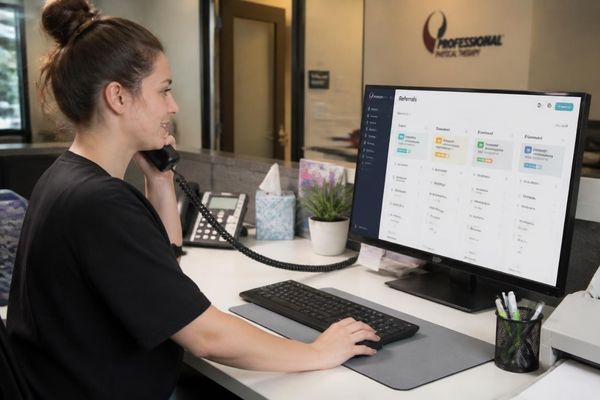
Inevitably, I had to open up a drawer, and there'd be a pile of faxed prescriptions for therapy that hadn't been worked. They were sitting there. We're looking to fill our schedules, and there are the prescriptions from 1 month ago, 2 weeks ago, or 6 weeks ago. The rage that would come into my head was crazy. It happened more than once.
To hear that there are automations that can go through the fax queue that don't have to be dealt with manually, whether or not a front desk person is doing their job and following the proper policy and procedure because you have an agent that goes in there, reads those, determines what is needed for that, and then goes ahead and handles some of these things is mind-blowing and exciting. People who use this automation don't have to go through what I went through.
I don't think every practice falls into this, but I think the vast majority of practices have plenty of demand. As people start to put everything in one place and they streamline, they find they have excess demand. There are still some practices that are like, “I could use more patients.” The first thing is, are you capturing all the people who are trying to raise their hand to you, or are there scripts that are either sitting in the fax tray, in a queue, or on someone's desk or whatever, and sourcing that demand? That's the number one thing you should be trying to do if you're trying to fill your schedule.
To take it a step further, not only is it capturing the people who want to schedule and get into your clinic because it is also scheduling them, but you can also give rules and parameters as to what is available and when. You can also optimize your payer mix of the schedule. That is what it sounds like, right?
From a cost-saving standpoint, allowing patients to self-serve is huge for a practice, but there's a little reticence to do that because initial evals are their own beast. You have different eval types, like pelvic floor eval or vestibular. You have only certain therapists that treat those types of evals. It's this idea that you have white space on your calendar. That's available, but is it bookable for an evaluation?
Setting Guardrails For Self-Scheduling
What we spent a lot of time with practices is understanding how to create a bookability layer that sits on top of the calendar. You can put rules in like, “I don't want a therapist to have any more than three evals a day.” You can put things like that that would allow the slots to be more accurate relative to what the practice is looking for in evaluations, if that makes sense. Payer mix is another layer on top of those booking rules. It's like case mix optimization. It's saying, “Based on who this person is, can I be more thoughtful about how I'm converting those leads?”
Lifting Revenue With Payer Mix Strategy
Typically, practices get all their leads, work them from top to bottom, and fill the open slots. However, we believe that there's an opportunity to think about who you convert and when to influence your net rate, especially if you're going through a third party. If you're billing through insurance on all of these claims, if you can move your top quartile payers up by a couple of percentage points and your bottom quartile payers down by a few, you're talking about a $4 or $5 lift on your net rate.
That's huge. We even coach like, “Your front desk's job is to fill the schedule.” We don't tell them to be mindful of which insurances get favorability, if you will, but we have to be judicious. If your clinic is at 65% Medicare, frankly, that puts a big stranglehold on what you can potentially bill out. In the same vein, if you've got 40% flat rate UnitedHealthcare payers, you're probably not doing very well.
You might want to be a little bit more judicious on what your case mix looks like. We don't necessarily train that into our front desk people, but with these automations, those efficiencies can be naturally put in place. Those people aren't necessarily denied initial evaluation slots, but maybe they're coming in at a later date. The availability is a little bit down the road.
That's the idea. For certain folks, the next available appointment might be next week. For others, it might be tomorrow. Frankly, if you're doing case mix optimization the right way, if you're able to see an uplift, and this is coming from our passion about physical therapy and private practice, our belief is that gives you the leverage to be able to then look over time and say, “I know I have enough demand.”
“I know that I could steer higher quality patient demand into my practice. I think I can afford, without any risks, to go out of network with my worst payer.” You know that there's enough demand behind it. You can make those bigger, more strategic decisions. A lot of people are afraid to make those because they're like, “That's 20% of my demand.” The question is, is there 20% more demand behind it that you're not spurting?
Patients want instant online booking, but your clinicians need protection from burnout. Smart calendar guardrails solve both.
That’s exactly right. To go a little bit deeper on that, they might say, “It's 20% of my demand.” In visits per week, but financially, is it 20% of your revenue? More than likely, it's closer to 10% or 12%. You can fix that by filling in the gaps with higher-paying patients, right?
Totally.
I love how you broke it down. The lead demand is coming through fax, phone call, and also websites. It's easy to see how automation can help on the fax side and the landing page side. What you told me before we pressed record is that an initial text might go out to the person. Is that how you start the communication with those people?
It's not even a static text. An AI agent can go out and initiate a conversation with them via text to get things scheduled. That's the idea.
What's cool is not just text. When someone calls in, you're using AI agents to answer the phone. Tell me about that a little bit.
People hate when AI calls them, but they're very comfortable with them calling and getting an AI agent, specifically if it's good. People have a lot of trouble having crappy AI experiences.
This is true.
For the vast majority of people, when it's good, they're perfectly fine operating with it. Where we believe the most important place to think about AI is not necessarily as the initial triage where it picks up as soon as a clinic gets a phone call. It's more about how you are going to deploy AI in the most strategic places.
Deploying Task-Specific AI Phone Support
Using a phone tree to be able to steer new patients over here and existing patients over there and billing questions upfront allows you to say, “If it's a new patient, maybe I have my AI agent that is specifically trained on scheduling a new patient pickup and be able to start having a conversation to convert them.” The approach is more specialized and task-oriented versus trying to design an AI that can handle everything, which is a little bit of a pie in the sky, if that makes sense.
I like how you talk about it being more specifically implemented because you might not want that AI agent to handle every call. There are some specific follow-up calls, cancellation calls, or billing questions that maybe you don't want an AI to answer. If it is your run-of-the-mill, “This person needs the schedule as a new patient,” then they can easily do that. If it's 7:30 PM on a Sunday night, the AI agent can handle that. I said this before also. People are expecting that kind of convenience. They don't want to wait until 9:00 AM Monday morning to make that call and set up the appointments.
I certainly am. I work from home. In between meetings, I grab my phone when I don't have time to make lunch, put in a lunch order in ten seconds, and then it shows up at my house. I depend on that level of convenience. That's undeniably being expected across all consumer experiences, which includes healthcare. People are looking for the ability to book on demand, frankly not have to talk to somebody when they don't want to talk to somebody, and be able to handle their appointments.
Before, you might've heard people say that they want the human touch or they need a human touch. I'm not feeling that nowadays. Convenience trumps the human connection on some of these routine activities.
Everyone has a different level of risk tolerance. What everyone that I've talked to can get behind is that if a human is there, you can make the decision whether or not the human picks up. If the phone has rang three times and it's about to go to voicemail, what's better? Is it somebody leaving a voicemail and then calling the next clinic or AI picking up? Certainly, it's AI picking up. When it's a Tuesday evening at 8:00 PM, and no one's there to pick up the phone, it's a no-brainer at that point who picks up. Even those who believe strongly in the human touch, using AI, if you flip it on its head, gives your front office the opportunity to be more human with the people they can be human with as well.
They don't have to be on the phone as they're bringing someone into the clinic for the first time, doing the intake process. They can get to know them and be personable with them. As someone's leaving, they can be like, “They need to reschedule. Let's do that now. I don't have to be on the phone and tell them, ‘Hold on. Wait a minute. I'll get to you after I finish this phone call.’”
I like how you said that in that case, because these automations have helped their efficiency, they can spend more time with people who are in front of them. Tell me. Am I missing anything else regarding automations that are super helpful with the technology that's available? We're talking about bringing leads in and getting them scheduled. Is part of the process also getting some initial collections of payments? Has it gone that far yet?
Underneath all of this is interoperability with EMRs and the like. It's one thing to gather patient information. It's another to create the patient, create the case, and put the appointment as an appointment request in the EMR. If this scheduled event takes place, and then it's sitting outside of your core system, and somebody has to look at it, call the patient, and confirm, that's not efficient. If the task happens, and then it integrates into the EMR, and they come in, and their insurance is already collected, we're getting somewhere. Primarily, to start, it's about integrating intercore systems. EMR billing is a must-have.
The initial scheduling event is the first conversion. The second is making sure that you have all the info that's required to get them converted. Can they send you a picture of their insurance card, and then that is uploaded into the system of record? Can you do an automated verification of benefits where applicable? Those are huge opportunities. Frankly, behind that is that as your team is trying to convert leads as they're coming in or as the AI is taking phone calls, there are people who are going to slip through the cracks. Finding other ways to initiate that conversation via email or up on text is where all the automations come into play.
I got you. Those aren't quite built out yet?
The only one that I mentioned that isn't fully built out is verification of benefits. We're in beta with verification of benefits. All the rest of them we support.
Does part of the program also provide the owner or the supervisor with some reporting of conversion rates and statistics so they don't have to go and dig for them? It’s such a pain in the butt for owners to dig through their EMRs, get stats, manually upload spreadsheets, and that kind of stuff. I'm assuming with this automation can come some reporting.
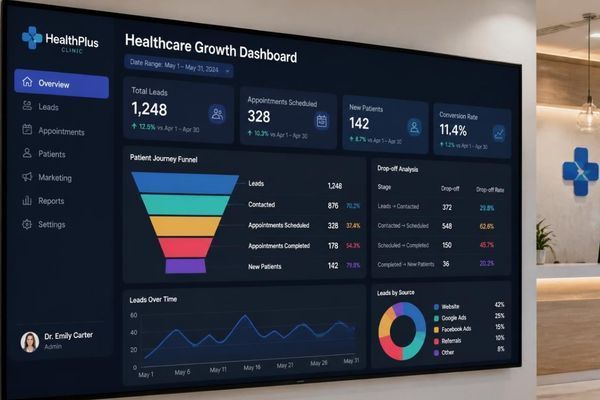
It’s where we started. Not everyone even understands how many leads they've gotten and what their demand is.
Don't force AI to do everything on the phone. Deploy specialized voice agents focused solely on converting new patient calls.
They almost can't get the conversion rate. You're relying on someone to manually say, “I received a call about starting therapy. This is who converted to initial eval, and this is who didn't.” It's a manual process that is inefficient.
Tracking Front Desk Conversion Gaps
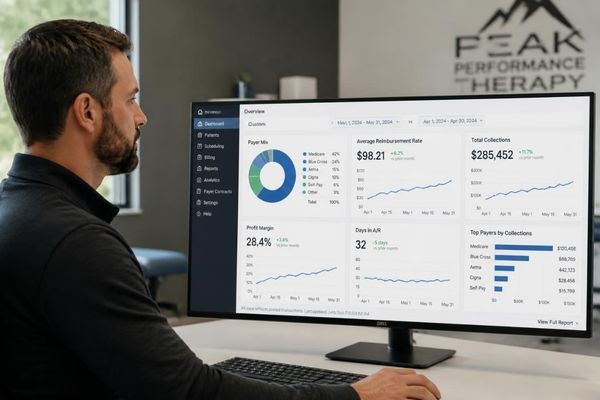
The opportunity is pretty clear. I got 400 leads. Of those 400, 75% got to schedule. Of the 75% that got to schedule, 92% attended. You can break it down by fax versus web. For people who are tech nerds like me, if you want to, you can integrate your Google Ads. Not just a web form filled out on a website, but it came from this pay-per-click ad. You’re getting that actual return on investment. I got twenty leads from this PPC ad on Google, and fifteen became patients. You're able to put an ROI on those types of campaigns.
It's all the things that sit underneath, like the conversion rate by the front desk person that's managing the conversion. There are massive discrepancies between the effectiveness of people that you can't measure until you see. When Susie owns it, it's at 80%. When Joe owns it, it's at 33%. Let's have Susie teach everyone how to do this because she is much better at converting. Those metrics are the most important thing out of all of this. It's how you can be actionable about the data you're seeing and continuing to refine.
Also, find out where the drop-off is happening or what is most successful so you can make quick decisions, like, “We need to improve this or we need to do more of that or this person needs more training,” etc. All this automation, not just in the processes and the cells, but in the reporting of it, helps you make decisions and training that much faster, which improves efficiency. I like it. I'm assuming it's not only saving owners money, but it is also making them more efficient, allowing them to generate more revenue because of the things that we've talked about.
There's the opportunity to reduce costs. My belief is that you can't just not have a front office. You can do things virtually, and the like, but ultimately, the core metric on costs that I'm looking to influence is visits per front office FTE. If I can create the efficiencies that double the amount of visits I can see with one FTE, that's a massive cost savings. What type of FTE do I need? Do I need an office manager that can handle everything, or do I need somebody who's a little bit more entry-level because the tasks are simpler? Those are all opportunities to save and then reduce some of the manual work.
In implementing something like this, you have to be able to see direct cost reduction in order for it to make sense, or at least net neutral. If everything else stayed the same from a cost perspective but your team didn't have to answer phone calls and your scheduling took care of itself, that might be worth it in and of itself.
That also might be based on other parameters you put in place.
That's right. In terms of optimizing schedule, there's a huge opportunity for revenue generation either through case mix optimization, making sure that the right folks are getting booked. If you have demand on the table, meaning you have open slots for evaluations, I would venture that you have plenty of demand and it's about the conversion rate that's leaving those slots open, not the actual demand.
With this, you don't have to lean on somebody to do the work to optimize that conversion.
That's right.
I love that. That’s very cool. We've been talking a lot about PT. Do you also cross over into the OT-speech side of things?
Rehab therapy is our focus. Frankly, we're best positioned to help private practices that are treating an adult population. I don't know that we have a ton of customers that are focused on pediatrics. That's me being honest in case we have folks like that tuning in. Whether it's OT, speech, or physical therapy, we handle it all. Those are all important considerations in scheduling. When somebody says, “I need occupational therapy,” let's make sure it gets on an occupational therapist's schedule. All of those things are built in.
I got you. You're not coming in, providing your own phone services. Someone can use a very general phone VoIP system or something like that, and you guys can integrate into that.
We integrate on the backend, on the EMR, and on the front end into a VoIP or into a phone system. We help you put our AI into your existing call tree so it picks up when you want it to pick up, and then we can transfer it back into the call tree, if need be, into voicemail.
You mentioned things that you're looking forward to doing in the near future. Your beta testing something about insurance verifications. Are there items out there that people should be looking at in the future to see where those automations can help?
Automating The Cancellation Waitlist
There’s verification of benefits. There’s off as well. It feels the same, but it's quite different. The requirements for both of those are very different in terms of what AI would do and how it would do it. All scheduled events, which include follow-ups, cancellations, no-shows, a waitlist, and how you are going to optimize your day-to-day calendar, are all areas that are ripe for automation and potentially AI.
Maybe it's not just the new patients, but it's handling cancellations and reschedulings. I love the idea of having a waitlist. Instead of waiting for someone to notice that there's an open spot in the schedule, there's a waitlist that, when someone cancels, it goes white, and the automation automatically reaches out to someone on the waitlist. It happens all in real-time.
The same thing is if you're pushing your patient self-scheduling and that visibility, some of that waitlist stuff takes care of itself. Somebody can grab a slot that is dropped off, too.
Maybe they're notified that a slot opened up, right?
Yes.
I like that idea. That’s so cool. Is there anything else you wanted to share, whether it's about things that people can look for in automations or about Second Door itself?
Open evaluation slots eat practice profits. Automated waitlist notifications fill same-day cancellations in seconds.
For folks who read a few years ago about the direct-to-employer side, I'll share a couple of things. For practices that have put their focus on direct-to-employer, it has yielded quite nicely for a good chunk of them. What we've learned is that it's a lot harder than what people think it is. It does require time, energy, and effort to get there. For a smaller private practice, and when I say smaller, I mean under ten locations, it is important to think about who you're targeting, too.
My strong advice is to go after municipalities, police, the fire department, school districts, and all of that because you have the clinic density to be able to cover all of their employees. It's hard to walk into an employer that has 3,000 employees and some employees that are in a different state and try to partner with them on something like this. What I'm trying to say is you can optimize what you have, but then thinking about alternative payers or partnerships to drive revenue is still the long-term fix in the industry. That's what we're passionate about at Second Door.
If people wanted to learn more about Second Door or even get in touch with you, how do they do that?
Ryan@SecondDoorHealth.com, or they can go to SecondDoor.app and take a look at that.
It's good to have you on again.
I appreciate you having me. It's a great conversation.
We'll have to bring you on when more automation comes into play. You can tell us what's happening.
Will do. That sounds great.
Thanks.
Important Links
- Ryan Klepps on LinkedIn
- Second Door Health
- Ryan@SecondDoorHealth.com
- How To Increase Reimbursement By Contracting Directly To Employers With Ryan Klepps Of Second Door Health
About Ryan Klepps

Learn how to fix your physical therapy billing, stop revenue leaks, and collect what you're owed with Nathan Shields and Matt Slimming.
Learn how to negotiate payer rates with Brace Health CEO David O'Hara. Discover how network leverage and direct outreach boost private practice revenue.
Learn how to build a better clinic culture with Adam Robin to retain top talent and drive long-term practice success.

Discover how Jason Wambold, MSPT of Prompt Compensation uses variable compensation models to boost clinic retention, recruitment, and provider productivity.
Learn how to optimize staffing ratios in your practice with expert Adam Robin to boost profit and streamline clinical and admin teams.
Learn the strategic steps of dropping low-paying insurances with high performance practice founder Adam Robin to maximize your clinic's profitability.
Master private practice marketing with Nathan Shields and Adam Robin as they reveal four simple referral buckets to scale your clinic consistently.
Learn how to prepare your physical therapy practice for exit as Nathan Shields and Paul Martin discuss physical therapy M&A, EBITDA, and practice valuation.

Learn how Nathan Shields and Adam Robin drive provider productivity through clear metrics, strong culture, and effective team communication in your practice.
Fix private practice billing profit leaks with Nathan Shields and Adam Robin. Learn essential KPIs, monthly meeting structures, and billing accountability.