
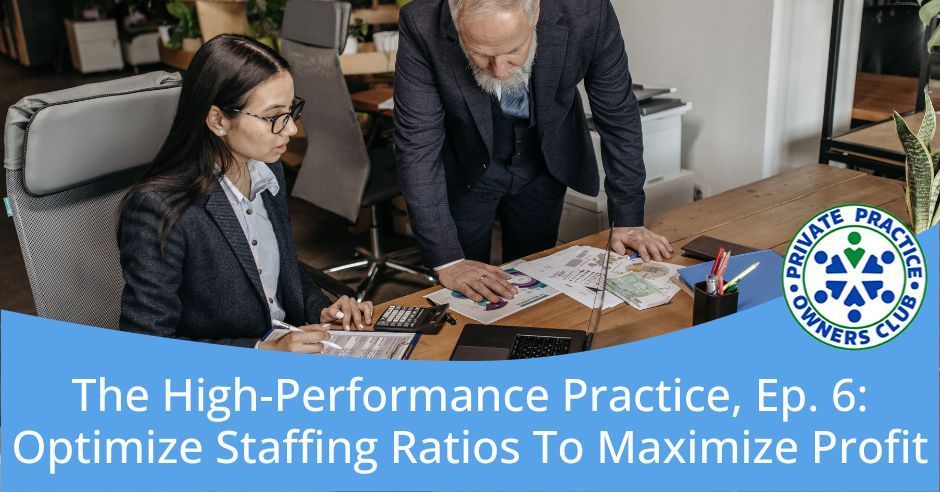
The High-Performance Practice, Ep. 6: Optimize Staffing Ratios To Maximize Profit
Staffing Ratios: How to Build a Leaner, More Profitable Practice
Payroll is one of the biggest expenses in a private practice and when staffing gets out of control, profitability can disappear quickly.
In Episode 6 of the High-Performance Practice Series, Nathan Shields and Adam Robin break down how practice owners can properly calibrate their clinical and administrative teams to maximize performance, efficiency, and profit.
Instead of simply hiring another person whenever the team feels overwhelmed, they discuss how to use financial benchmarks, productivity metrics, technology, AI, and virtual assistants to build a more efficient practice.
In this episode, you'll learn:
● Why employee compensation can be your practice's biggest expense
● How to keep total employee compensation within a healthy revenue ratio
● The 2.5–3.5x compensation-to-revenue productivity benchmark
● Why hiring another person isn't always the solution
● How to create and manage an admin staffing budget
● Why every practice needs to be evaluated based on its own financials
● How technology and virtual assistants can reduce administrative costs
● How to simplify and eliminate unnecessary processes
● Why constraints can create innovation
● How AI can improve patient communication and scheduling
● How virtual assistants can support your front desk
● How to determine when your front desk needs additional support
● Why keeping operations lean can improve profitability
● How technology can help practices maintain a cleaner revenue cycle
● Why practice owners need to continuously test, measure, and improve their systems
The goal isn't simply to have fewer employees. It's to build a high-performing team with the right people doing the right work at the right cost.
If you want to build a practice that is more efficient, profitable, and scalable, this episode is for you.
Don't just hire more people. Build better systems.
---
Listen to the Podcast here
The High-Performance Practice, Ep. 6: Optimize Staffing Ratios To Maximize Profit
Calibrating Staffing Ratios For Maximum Profit
Quick heads-up for all the private practice owners who are tuning in. If you've been tuning in for a while, you know that it took me at least ten years of grinding in my own clinics before I finally figured out how to scale and sell my four practices for seven figures and about three times the national average. The biggest shift was not some secret marketing hack. It was how I thought about profit, systems, and actually my role as the owner.
That's exactly what we're going to be working on together with you at the High-Performance Practice Conference this fall in San Antonio, Texas. From October 15th through 17th, Adam Robin and I are hosting a three-day hands-on event for PT, OT, speech, mental health, PEDs, pelvic floor, and medical practice owners who want to build clinics that are profitable, scalable, and, best of all, do not depend on them 24/7.
We'll dig into simple profit and KPI frameworks, real leadership and culture work, and practical systems you can take home and plug in with your team. If you're doing roughly 6 to 7 low figures a year and you want your clinic to feel more like a real business and less like a job/cage, I'd love to see you there. Frankly, I'd love to see you bring your leadership teams as well because we will have breakout sessions for them too. Let's get into this episode.
---
I got my partner, Adam Robin. How are you doing?
Fired up as always.
This is episode six of the High-Performance Practice series. In this episode, we're talking about staffing ratios. How to properly calibrate your clinical and admin teams to maximize performance and profit. There are a few numbers that will go off of but before we push the record, you broke it down pretty easily. If I asked you, could you regurgitate what you just said?
Staffing ratios, first of all, your payroll expenses, your employee compensation is going to be by far the most expensive thing in your practice. We all know that because we see the big bill that comes out every two weeks. The one that cuts your bank account in half. It's easy to let that get out of control. What I usually see is, it’s hard to find therapists to find and to retain therapists or clinicians. We end up even more so paying them a little bit more because we have to figure out a way to keep the doors open.
We're a little bit softer on them so they don't have to be as productive. We end up getting into an issue where what the therapist is producing for what they're getting paid is no longer an even exchange for the company and you could run into some issues there. A few places to start is, I like to start with the financials. If the finances don't work, it doesn't matter how nice of a person you are. You're going out of business. That's an objective thing that has to be right before you can even talk about playing nice.
If the finances don't work, it doesn't matter how nice of a person you are. You're going out of business. At the end of the day, math has to be math.
You can decide if you want to be ethical or not or if that's ethical. That's a whole other decision. At the end of the day, math has to be math. Traditionally, we want to try to find a way for no more than 55% to 60% of your revenue to be spent on total employee compensation.
The Financial Benchmarks: Balancing Payroll And Revenue Ratios
Salary plus benefits plus paid time off. All that stuff.
All the things. That's your budget for both clinicians and admin total.
Make sure you're taking a salary in there as well.
Correct. That's everyone getting paid. Everyone gets paid. If we can go by the model that each clinician needs to generate roughly 2.5 to 3.5 times their total compensation and revenue per year per year. If you understand your average revenue per visit, then you can start understanding what's left over for you to spend on admin and non-clinical labor. An admin budget, that's a great way to look at it. The easy thing to do is whenever you get busy, hire another person. The easy thing to do is when you get anxious, hire another person.
If they can fog a mirror, bring them on.
If I can get this person to answer my emails or whatever. I'm overwhelmed. I hired someone because that's going to solve the problem. The harder thing to do is to learn how to get better, to learn how to be more efficient and to improve your systems. That's what pays. I challenge you all to focus on that. Once that budget's there, it's a budget. You have to figure out how to get it done with that amount. That means you may have to pivot. Hopefully, that lands the way it's supposed to.
It does because you broke it down into the financials, which is necessary. You brought up a couple ratios that need to be on the radar of everyone's KPI lists. That is, on a monthly basis, you're looking at your profit and loss statement. What is my compensation ratio to the overall rate of revenue? It's got a stable low 60%. I did an audit of someone who was in the low 70% and guess what? They were struggling to make ends meet. They had a single digit profit margin and any hiccup in payroll or reimbursements was going to deplete their savings.

I've seen it in real life and this was a multimillion-dollar practice. Their compensation ratio was out of whack. Your team has to be productive with the compensation that they're receiving. Two and a half to three and a half times their compensation is an appropriate metric to go off of. This is what we can reasonably afford. If they're not doing that, then it's an easy solution. You have to find a way to make them more productive.
If they need to see more visits, then they need to be trained on how to build better. Do you as an owner need to go and negotiate some contracts or drop some of your lower pairs or your average reimbursement comes up? There's a cascade of events that can happen, but all these things are meant to ensure that you stay within these ratios that we're talking about.
It used to be the clinical to admin ratio was about 1 to 1. I don't know if that still stands considering the increase in salaries from many years ago and the relatively neutral changes in reimbursement. What we do have nowadays that we didn't back then as access to technologies and external sources to minimize the cost of that admin team. I know you've leveraged a few yourself. You've got Inbox Zero. Talk to us a little bit about that and what you've seen. How have you've been able to offset some of those admin expenses and make your team more productive at the same time?
Those are two different problems but it's dangerous, too. You've mentioned the clinical to admin ratio was 1 to 1 or was 1 to 1. That's a little bit of a dangerous way to look at it, especially because the way that you run a clinic in South Mississippi is going to be a lot different than the way you run it in Alaska. Your compensation rates, your overhead and your operational cost like all of that can be so different. Therefore, your reimbursement per visit is going to be different. Your productivity standards will be different.
I don't know if that's a racial that holds water much anymore.

I don't think so. Every single business is unique and must be treated as such. Now, there's some general guidelines, but again, it comes down to the financial. It might be 1 to 10. If that's what it is, that's what it is. That's whatever. I’m not saying that that's an easy thing to do but that might be the case. Going back to the question. It was, how do we start leveraging VA?
How do you leverage technology and/or VAs to minimize the expense or increase the efficiencies or optimizations?
Driving Efficiency By Simplifying Systems And Eliminating Complexity
You have to eliminate it. Elimination is probably the biggest lever to pull. How do we make things easier? How do we make things more simple?
What do you mean by eliminate?
Remove steps. Remove complexity. Simplify. Maybe that's a better way to say it. I understand not everybody's like me, but I'm a little bit of a micromanager. I like my details in order. I want every T crossed and every dot I. I tend to hyper fixate on details because I'm trying to create control uncertainty when I'm building systems. Sometimes, I can end up over-engineering the complexity and a lot of the things that we do, like the way we onboard, the way we deliver care and the way the front desk runs. It can cloud the priority because they're so many steps.
One of the things that you can do, especially if you have a team, is simply get in a circle. What can we eliminate from this process? How can we cut this down into only the essential things that matter and be okay with some of the non-essential things not being the way they are now? Spending 90 days doing that, you could save a lot of money. You can save a lot of overhead.
In those same conversations, have you ever challenged your teams or asked them, “Are you leveraging everything you can out of the software programs that we have? Are we leveraging every possible available piece of software that we have to make this easier for us? Has that ever been a conversation? You and I both know there's plenty of things that are available to us in our softwares that we're not leveraging that probably could make things easier but we just don't have the time necessary. Has that ever been an issue?
Being more efficient takes time and energy. There's a cost to it and it's work. It's work to figure that out. We've used AI a lot. Not so much on our practice as much, but in other companies. We've done AI to help with onboarding and inbox management and workflow building and process building. There's a lot of things you can do with AI. When you're talking about becoming more efficient or simplifying. What you're talking about is innovating.
Elimination is probably the biggest lever to pull. How do we make things easier? How do we make things more simple? Remove steps. Remove complexity. Simplify.
You're innovating the process. You're becoming more efficient. Maybe innovating is not the right word, but that's how I think about it. In my opinion, the thing that creates innovation is constraint. Something has to be heavy, hard and inefficient. You have to sit with discomfort long enough for you to realize, “We have to figure out a way to do it differently.” The burden of the leader is that you are the one that has to bring that discomfort to the meeting because everybody on the team wants to be paid and they want to have a piece of the party.
They want to hire more people just like you do. You're the person that understands that has the wisdom to know that if I keep doing this, I'm going to run out of money. Sometimes, it's as simple as asking a hard question in the meeting, which could be, “How do we do this quicker? How long did it take us to onboard that person, 30 days? What would have to be true for us to do this in fourteen days?” To sit with that, breaks your brain a little bit. To sit with that discomfort in the pressure of having to answer that question, a lot of times, you'll reach some innovation.
I'm going to land one more point that I think it's important. I also think it's required to commit. A lot of times, I see teams who will want to solve this problem of efficiency. In their mind, they'll say something like, “Before I can commit to that, let me figure out how to solve it all. How am I going to do this? How is this going to work?” Virtual front desk is an example. How am I going to collect the co-payments? How am I going to do this? If I can solve all the hows, then I'll eventually try to commit if it makes sense. You end up wasting so much time, instead of saying, “We're going to commit to this and then we'll figure out how along the way.” If you get committed and you force some innovation, you'll probably breed something efficient.
Harnessing AI And After-Hours Automation To Boost Conversions
We had a group call where we were talking about leveraging AI and technological options that are out there. One of them being a virtual kiosk at the front desk. The thing I wanted to highlight for those people was make sure you set it up so you're not in a long-term commitment to anything, but don't be afraid to try it. Let's try it. Let's track what we're trying to accomplish here by leveraging these things, and get some patient feedback at the same time, if it involves them.
Be okay with cutting the cord. We tried it. Let's move on to plan B or plan C. Let's maybe have some intentionality around, what do we do if it doesn't do what we want? Let's plan for that. Let's expect that. What are the KPIs that we're expecting to improve by implementing this thing? Go into it with some intentionality and some goals. Instead of saying, “That sounds like a cool idea. Let's try it. Let's bring in a virtual kiosk and see what happens.”
The guy on our call wasn't talking about virtual kiosks. He just signed on to an AI system that will book initial evals after hours. If someone texts in or emails in, this program will respond. It will totally upload all the patient demographics into the EMR and book the initial appointment without talking to a person. Within a few weeks, their conversion rate went from 65% to 75%.
That’s an example of KPI news tracking. We have people that are calling after hours. You and I both know people want easy access at all hours of the day and on the weekends or else, they'll find a different clinic. This program allowed for him, for these people who are looking for therapy to sign up after hours. It's all done electronically. You show up the next day and you've got more evals on the books than you did when you left the office.
The thing that creates innovation is constraint. Something has to be heavy, hard, and inefficient for you to realize you have to figure out a way to do it differently.
As an example of how you can leverage technology in the after-hours. Otherwise, those people might have been lost to other clinics. You're losing potential revenue in those cases. There are opportunities like that out there. How to leverage text messaging with your patients, how to leverage the front desk kiosk like we're talking about, and how to accept calls after hours or on the weekends. This can be technology in the form of AI or some kiosk like we're talking about or an app. It could also be virtual assistance answering text immediately in response to a patient's inquiries. There's a lot of opportunities there that go above and beyond what someone at the front desk can do.
Totally. I love how you said, just like, “Try it.” If you're the CEO, it is your job to be continuously testing and innovating new ideas, always and learning something. Learn something. Learn how to do something new. Evolve. Get better. That's how I started the whole Inbox Zero company because I hired a virtual assistant.
I was like, “I'm going to do this for 90 days. I'm going to learn it.” It was ugly for a while, but I committed to it. Through that commitment, I learned a new skill. I was like, “I could leverage this in other areas.” It's a good idea. You should always be testing something. You can pick something that is low risk that you could afford to fail. Maybe if you've never had a VA, you don't want to put it on like at the front desk with the kiosk. Maybe you put them in the back and you work with him privately for a while.
You’re still in verification.
That could be an example of a stair step approach. That's a good point.
We talked a little bit about the front desk. Since we're also talking about ratios, what are you seeing? You leverage VAs to support the front desk. You don't have a virtual kiosk at this point yet, do you?
Not yet. It's in the works. The only reason I don't is because I've got the best front desk team in the country. They are so good. It took a long time to get them there.
You did a lot of good training. I know.
A lot of training and strength on boarding.

They own that position. They own KPIs. They report. Even then, what you're telling me is that you see the potential benefit of a virtual kiosk.
We're doing it.
Some people would say, “My front desk is great. Why would I need that?” I see some benefits that could support them.
Let's be real. The front desk is not a career position. It's only going to last so long. You got to open a lot of clinics to get every admin person on your team to make six figures. In some areas of the country, you can, but we've got probably the bottom half of our talent. I probably don't have anywhere for them to go. I'm trying to get them back in college. I want them to leave and earn more money. I want to help strengthen their resume and help them get their next job to where they're at like $30 an hour or something way more. That's my calling for them. As soon as they leave, we're coming in. It's already in the works. We're going to do the whole virtual thing.
Calibrating Front Desk To Patient Visit Ratios
Considering your leveraging technology at the front desk. What is that ratio? People ask us on Facebook quite often. What's the ratio of full-time front desk personnel to visits per week?
Good question.
Have you honed that in?
Again, it's going to depend.
On what you ask your front desk to do.
Yes, and what area of the country. It’s like, are you in network with Medicaid? How many authorizations are you doing a week? Are they doing authorizations? Are they doing the verification? Do you have AI doing that? There's a lot of questions there but I can give you some generalities. If you're starting up a clinic and you're like, “I have to figure out a way to save money. I'm going to get this front desk person.” They're going to do all the offs, all the verifications and all the billing. That's a lot. First of all, they're going to know that business well. You probably can't get that person beyond 60 or 70 visits a week before they start crying. You have to decide, “I've got to get rid of these offs.”
Get rid of the billing first. Who's an expert to take care of the billing?
If you're the CEO, it is your job to be continuously testing and innovating new ideas, always learning and evolving.
If you're not doing the billing, if you're doing some outsourced billing, which is usually a good idea. As long as you have a good partner there. I would say probably somewhere around 120 visits so weak where a good front desk person could land productively and keep the schedule full.
It's about max. That's the expectation. That's about the maximum. When you hit that 120-125 mark on a weekly basis you know that it's time to look for another part-time or full-time support there. Also, be looking for someone to offload the verifications and authorizations from them. Otherwise, they're missing potential over the counter collections, reschedules. They're not getting a lot of calls. They're not improving. The main job is to fill the schedules. If they're distracted by other things, then it’s hard for them to maximize their job.
What you do is you hire a part-time VA. Take all the verifications, the offs, the reporting and billing support. You free that front desk person up to climb to maybe 180 visits a week or closer to 200. Now, your staffed well. At 200 visits a week, you're probably roughly 3 to 4 FTEs, depending on your product production. You're like 1.5 and the VA is not one of 0.5. It's like a 1.2 admin to 4 to 5 clinicians. You can do that. In that scenario, which is more optimized, you can afford to pay your front desk a little more. You could afford to pay your clinicians a little more.
Even that with a full-time person. If you're getting to 180, the fear I have there once they're getting past 150 or so, you're like one sick day or a few sick days away from helping them. You want to have someone as a support there, learning the systems and backing them up just because.
You could do that.
In your situation specifically. That's where you're talking the virtual option comes into play.
I love what we do at Inbox Zero, don't get me wrong, but this is not a sales pitch for Inbox Zero. There are more affordable options to hiring an extra body to sit around and watch your front desk do things. You could have a kiosk ready for those situations and you could have fill-ins for those random sick days to keep you afloat and make sure those collections stay. That's what's going to fall. It’s the collections and the utilization. There are options to do that more affordably.
Have you leveraged any of the AI technologies that might answer text messages or even phone calls?

I have not
The phone call one, where it's an actual voice, I haven't heard too much about. It seems like the text option has become pretty good about communicating with people via text. You can have patients via text as an AI bot and not a real person. I'm hearing good things about it.
I'm sure it's going to be great. We've been doing that since they've had the little chat bubble that popped up on the website. It's pretty much the same thing.
That's where people have to recognize that changes are coming. The question that we were grappling with a little bit in our group was patience and 24/7 access to everything. You and I grew up in an age and time when you called during business hours, or you left a voicemail after hours where people are starting to expect and use technology to interact with you 24/7, 365. For those people who might shy away because that's not the person contact that they appreciate or that they think that their patients want.
More and more patients are expecting some digital interactions so they can interact on their phone when they're thinking about it. The reason I bring this up is because one of the guys on the call said, “We notice from our Google ads that we were getting a lot of traffic on Sunday nights.” People in this day and age, when they get a hankering or they get an idea, they're not making a note to call the physical therapy clinic tomorrow morning. They’re like, “I'm going to do it now,” because when he called them back on Monday morning, it was too late. They had already scheduled another PT Clinic.
Now, he's implemented a resource that can respond to them on some nights when most people are online. He got a greater conversion rate and those people are booked the next day by the next day. If you're not considering that as an option and maybe your community has some other expectations in what you're used to. Those are the owners that are going to maximize and they're going to do more. They can move along with technology to improve the services they offer.
Cutting Admin Overhead To Protect Margins And Retain Clinical Talent
I don't believe that we're at a place where everyone is just going to go out a network and be 100% cash. That's not going to happen. You're going to have to take insurance. It's just going to be part of it. Most of us. There's going to be demand, but one thing that you cannot create more of is clinicians. There's only so many. There's only so many. They have to have a license. They have to graduate from an accredited University and be in good standing. There's only so many of them.
Your company will rise and fall to the degree in which you can hire and retain great clinicians. They’re the most valuable part of the practice.
Your company will rise and fall to you to the degree in which you could hire and retain great clinicians. They’re the most expensive part of the practice. They’re the most valuable part of the practice. It's not going to be easy for you to cut their pay and raise their production and fix your money problems. That's not going to happen because the hospital systems are going to give them a $5 an hour raise and they're going to leave and see less patience. It's hard to manipulate that bucket, that expense bucket.
The easiest thing that can be changed is the way you manage the admin and the operations. The way you leverage technology and all shore labor. You can cut that in half. Run your numbers. Run your numbers on your non-clinical labor and your operational costs. I guarantee you, you're in the 30% bracket. What happens if you get that down to 20% or 15% through the use of technology and AI? All of a sudden, you're playing a different game. You go into work and you get a little more confidence.
You’re like, “I've got some options. I can afford to pay that guy $100,000 dollars and keep him. Now, I can make moves.” I would just encourage people to consider that is where practices are going to thrive. How well can you keep lean operations, and keep a clean revenue cycle? That's going to make or break you so that you can keep your clinicians happy.
We're going to have some people talking about virtual assistants yourself, especially as well as some people talking about virtual kiosks conferences and October 15th through 17th. This episode all led us up into that conference, which is in San Antonio on October 15th, through 17. Go to PPOClubEvents.com to check it out and register ASAP because when this comes out, we're probably going to be probably a few weeks away.

If you want to learn more about the potentialities that virtual kiosks can do for you or even EMRs that can do some of these things for you already. Some communication tools or even people representing virtual assistant companies like Adam at Inbox Zero. It will all be there and available to talk about all in one place. Instead of making separate calls, have a fun trip to San Antonio on the business and talk to them all at once in person. You can get to know what's happening out there. Make sure you look at PPOClubEvents.com to register. We covered a lot that I was thinking about in terms of optimizing the ratios, the dynamics and leveraging technology. Is there anything else that you wanted to add?
No, we pretty much did it. This is the problem to solve.
These are the things that are coming up against and a lot of people are hesitant when it comes to leveraging technology. One of our overarching messages is “Try it. It can make you and your team more efficient. It can optimize your practice so you can put more towards the providers.” There's also a part of the community that is expecting some of these technological advancements to be leveraged. People don't want to think about it from a collection’s perspective. When someone tells me to write a check and send it to them in the mail, nowadays. I just want to say, “I'll find someone else.”
“We're no longer friends.”
If your patients are getting mailed statements, provide them some options. Let them pay via text. Have them go to a payment portal online. Even that is cumbersome. Send me a text and tell me how much I owe and give me the link to pay it so we can finish this. The community is expecting some of these technologies to be put into place, and we should expect to provide these if we're going to maximize our efficiencies in our practices.

Adapting To Modern Consumer Expectations For 24/7 Convenience
I have two things. Number one, this is not just in healthcare. The cash flow crunches and the challenges that we're experiencing in healthcare are not unique to healthcare. They are across the board, unless you're in some type of technology and you're making a bunch of money. Businesses are having a hard time innovating. They're passing a lot of expenses onto the customer and they're automating a lot of their operations. That is where the world's going.
I'm trying to figure it out. Come to the conference and figure it out with me. The other thing is, I don't know if I mentioned I'm building an outdoor kitchen at my house. I was calling those stainless steel doors that you have to put on the front? I had to call the company. I was going around calling companies trying to figure out where I was going to buy them and it was a Saturday. I called three companies. The first two did not answer. They made me leave an even email. They had to email their support and they were going to get back to me on office hours. The third people, I submitted a ticket and they called me instantly. I got on the phone with them, and they made a deal right there on a Saturday. They got my business. I just wanted to share that story. It's like that pays off.
People will pay for convenience.
I feel appreciated on a Saturday. I'm like, “Nobody works on Saturdays.” It was like a real human calling me too. It's cool.
Check out PPOClubEvents.com. We'll see you at the conference. This wraps up episode six of the High-Performance Practice series. We'll catch you later.
Important Links
- Nathan Shields on LinkedIn
- Adam Robin on LinkedIn
- Inbox Zero
- PPO Club Events
- High-Performance Practice Conference
- Annual 2026 PPOClub Conference Registration