Most practice owners feel the pressure to “keep up with AI” — but few have real clarity on what actually works, what’s hype, and what could quietly overwhelm their team.
In this episode of the Private Practice Owners Club Podcast, host Nathan Shields sits down with
Sharif Zeid, longtime EMR leader and representative of
Empower EMR, for a grounded, practical conversation about where AI is truly delivering value in private practice — and where expectations need a serious reset.
Drawing on years of experience working with hundreds of practices, Sharif breaks down how AI adoption is accelerating faster than any technology wave we’ve seen before — and why documentation, scheduling, compliance, and phone systems are at the center of that shift. They also unpack the hidden risks of chasing tools without systems, and why “AI as the solution” fails without strong operational foundations.
Together, they explore:
- Why documentation is still AI’s biggest and safest win for practices
- How generative AI (scribes, summaries, chart review) is actually being used in real clinics
- Why “perfect” AI is the wrong benchmark — and how partial wins still create massive ROI
- The growing AI arms race between providers and insurance companies
- Where AI helps with compliance — and why trust-but-verify still matters
- Why billing automation is over-promised and under-delivered (for now)
- The real cost of stacking tools — and how to evaluate ROI per provider
- Why team overwhelm is the biggest risk of fast AI adoption
- The rise of AI in phone systems, scheduling, and patient self-service
- Why patient portals and foundational systems must come before automation
- How AI should support decision-making, not replace leadership
If you’re a practice owner trying to decide where AI actually belongs in your clinic — and how to adopt it without breaking your team, your culture, or your systems — this episode offers clarity without hype.
🎯 Takeaway: AI isn’t the system — it’s a tool. Practices that win will be the ones that build strong foundations, guide the technology intentionally, and keep humans firmly in the driver’s seat.
👉 Learn more about Empower EMR:
https://www.empoweremr.com
👉 Want help evaluating systems, operations, and growth strategy? Book a call with Nathan — https://calendly.com/ptoclub/discoverycall
❤️ Love the show? Subscribe, rate, review, and share!
https://ptoclub.com
💬 Join the PPOClub community and access resources:
https://linktr.ee/ppoclub
---
Listen to the Podcast here
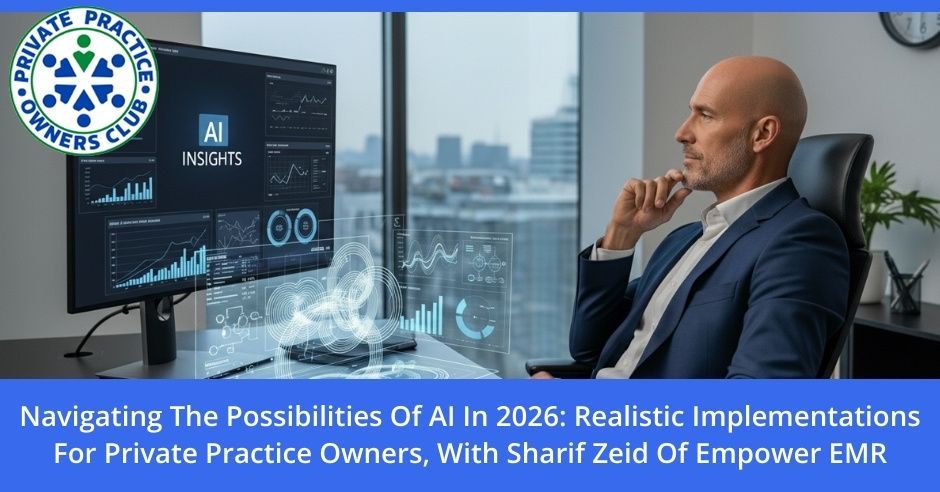
Navigating The Possibilities Of AI In 2026: Realistic Implementations For Private Practice Owners, With Sharif Zeid Of Empower EMR
I’ve got a returning guest, he's been a frequent flyer, Sharif Zeid of Empower EMR. How are you doing, Sharif?
I'm doing great. How are you doing?
I'm doing great. It's so good to have you on again. I know we check in every so often and we've seen each other at the conference, we saw each other at the workshop in New Orleans for the first annual strategic planning. It's good to see them there but it's also good to connect and maybe talk a little bit more about business for everybody.
Yeah, what a blast. Great job to you guys with the event and hats off to all for the continued success. It's been awesome to be a part of it from our perspective and role and getting to come to these events and talk and share our product but also participate and hopefully add some value along the way.
Definitely, and you do so. I really appreciate that. In our conversations here on the podcast and at the conferences, you are a representative of Empower EMR and I know you're ultimately there to invite people to sign on to Empower EMR, but in all your presentations, you provide a ton of value whether it's like I said here or at the conference, so I appreciate that. Thank you so much.
I think the perspective I bring is getting to work with a lot of practices over a long span of time and I think that's really where one of the most common questions we get, like if you think about clinical stuff like the thing with outcomes is always like, “How am I doing compared to my peers?” That's always the question and the same can be extended to financial questions. “Is this a good profit margin? Is this how much a visit should cost? Is this a good reimbursement?” The theme is always how am I doing compared to my peers?
I feel like and I know you have this perspective, too, you get to talk and work with a lot of practices you just see a lot and you see the good, the bad, the ugly and then you see it longitudinally over time where you're like, “What were we talking about five years ago?” What were we even talking about in 2025, 2024 and now here we are in early ‘26 and it's already like just a lot of stuff happening, the space is moving very fast, some overwhelm maybe happening, so there's just a lot going on.
We did have this conversation and you said that changes that are happening in AI are happening even faster. We had this conversation maybe a year, year and a half ago on the show about what people can expect with AI because it was just coming into play where AI was becoming a thing in terms of especially the dictation services that are out there and maybe some billing components related to AI and what not.
Now there's even more coming forward and it seemed like that at PPS there were like AI dominated a lot of the booths, that was the buzzword and of course there's a lot that they say is possible but not sure how functional. It's good to talk to you now and to see, now we're in 2026, with all the change that's happened in a year and a half, what do we have some clarity on what it can do for us for now that could again change another 6 to 8 months. It's good to have this conversation.
AI In Documentation (Generative AI/Ambient Scribe)
I think the pace is definitely a central part of the conversation in terms of how fast things are moving from a year and a half ago. We're a long way out in terms of innovations that have come out already and obviously what brewing out there. I would start by saying some things maybe haven't changed, so let's start with that. The list is fairly short but there's some things.
One is I think AI is this big topic, big thing, but generative AI, which is what most people experience personally and like on Google search or Gemini or chatgpt or whatever your flavor is and that's the like writing, reading, summarizing, those sorts of things, which is what made it a very natural fit for documentation purposes, long a thorn in everybody's shoe.
I think what hasn't changed is that it's really has shown tremendous value in that arena, in the documentation arena. There are flavors of it. The most common one is ambient scribe. You're recording the visit or you're recording a brain dump and this is seeing widespread, I would say, proliferation, a lot of clinics are using it, a lot are not still. There's a lot of opportunity for some to give it a try if they haven't. The technology curve is always early adopters and then you've got that middle.
The Fast Pace Of AI Adoption
Let me just give you like a little perspective historically. EMR for PT came into the world around ‘06, ’07, just to give you like a rough idea, when a physical therapy specific EMR actually existed versus let me go get some hospital system or something like that. The main adoption wave didn't happen until I would say about 2010, ‘11. You had a lot ramping heavily from ‘07, ‘08, ‘09, ‘10, then you hit this curve and say by 2012, most practices had an EMR and then you were on the back side of that curve.
What's interesting with this stuff is that that curve is happening much faster now. Generative AI, scribe comes out, it's a few years old now from the day it was first released and so many practices have done it and it won't take that many years for adoption to complete, I think, because people are seeing it. It's not for everybody. In some settings and some types of care, it's not providing value, at least to some eyes. My personal view is like, don't let perfect be the enemy of better and we talk about that all the time. If it can do half of your notes, it's half of your notes. I get that all the time like, “It's only helping me with a quarter of my notes.” I'm like, “That sounds pretty awesome, like 25%? That sounds good.”
Don’t let perfect be the enemy of better.
Sounds like a few minutes every day, at least.
Exactly. It's interesting perspectives or expectations maybe is the right word. If it can't do 100% of my notes for 100% of my providers, is it still good? I would say absolutely. Even if it's 25% for 25% of your providers, that's a serious improvement. Now there are other flavors of it, like we offer another concept with our Empower AI and there's just different takes on it.
Where I'm going with all this is the generative AI, the stuff you really know is kicking butt and it is what it does well, like, “Summarize this chart for me,” or, “Read this thing and tell me what it says,” or, “Let me give you a few pointers and then you write it up for me.” If you're not using that, I certainly think it's like you got to check it out at least and give it a try and again, just expect varying levels of happiness and adoption and try and make a decision that's balanced and reasonable and try and take the win, if you can.
You really have to consider who you're working with as well because I know a number of clinics, maybe they have 5 or 6 providers and 4 of them love it, like they would never use anything else, never go back to anything else, and there are 2 people who just can't either can't figure it out or they're just not tech savvy. If they could do it all over again, they'd go back to paper notes. There's no reason to throw the baby out with bath water. These people are loving it, just let them do it and keep going that way and accommodate for your team.
High Expectations & The "AI Wars" (Provider Vs. Insurance AI)
Isn't that true for everything or should it be true for everything? If you introduce a new clinical methodology or method or system or machine or equipment and some take to it and some don't, you didn't hear a lot of people like, “We're going to return the treadmill because everybody loves it but Nathan and he just won't use it with patients, so why should we have it?”
People have a different mindset with technology, so I think that hasn't changed. What has changed is expectations are sky high for what AI can do, so that is interesting because some of it may be a little dreaming and hoping and that's never a bad thing in technology because that's where things come from. Trying to right size expectations for today's world with what it can do, that's one. Expectations are high. Second one is AI wars, I call them, meaning clearly providers, practices are planning to use or are using AI to take a bite out of insurance and I think insurances are preparing to use AI to take a bite right back. Let me give you an example.
It’s already been done to some extent.
No doubt. It's just amplified. Everything is and they have more resources. What else is interesting is they have more data and that's always a powerful tool in AI right because the more data you have, the more patterns you can draw and that makes you more powerful. A simple example of it is like I'm going to have AI call all these annoying insurances and get auths because insurances don't do things until they have to.
They didn't allow for e-claims until essentially it got overwhelming the paper claims. You want to make it as hard as they can until they're like, “It's costing us too much now. Everybody has to do electronic claims.” This is like 10 or 15 years ago now, whatever. Authorizations is so silly they could have made that accessible and driven off of 1990s technology if they wanted to but they're not in the business of you getting an auth being easy. Providers are ramped up right now, practices like, “Alright, here we go. We're going to have you know Nathan AI call and annoy the insurance for an auth.”
I'm curious. I'm laughing in my own head as to how long it will take before the insurances figure out what a waste of money it is to put a live rep on the phone to talk to an AI and then they're just going to pigeonhole everybody back into a very classic technology like just request an auth through this portal or through this mechanism or through a clearinghouse, whatever, they'll figure it out.
The AI wars are interesting, I think it'll come for claims too. It'll be very interesting to see what happens with documentation because, again, looking longitudinally over a long period of time, compliance was a huge issue several years ago. It's like all you went to conferences every talk was about compliance and Medicare audits and RACs and all those things they used to talk about. It faded out a little bit. Certainly, if you're getting audited, it's a very real thing for you but I'm just talking broadly across the industry.
Cost/Value Of AI Tools & Overwhelm For Team Members
The AI wars are ramping up. Expectations are sky high. AI wars are crazy and the third thing I would say is just really trying to narrow down what you actually need and then having the conversation about cost. I think this just such an interesting thing. I’ve been in the space for a long time, so when you're starting a new business, you're trying to find product market fit and what can you charge for this thing. This is all right now the Wild Wild West, like EMR was years ago.
The AI wars are ramping up, and expectations are sky-high. The key is to focus on what you actually need.
Nobody knew what to charge for it, it was a testing ground and everybody was just feeling around in the dark until it settled in. In the last couple of years, some are really pushing what you can so what you could pay per provider for your systems and tools. I think one of the great interesting things is like where is this all going? Is it reasonable for a practice to pay $800 a month for tooling let's call it?
EMR of course is part of that, but then there's like what if you get three AI tools and you start breaking down this cost and it per provider which is the most I just think most intelligible way to think about it is like, “We're like pushing $1,000 on this stuff. We're pushing $800, $700. Is that right? Is that okay?” Do they really see an extra five patients a month that somehow justifies that? That becomes the push and pull.
The last thing I'd add is the overwhelm is real, I think. Practice owners are obviously trying to rush to stay competitive and find the right tools and so forth sometimes with expectations a little exceeding, like I said, what's actually out there. Your team is still like, “What is happening? I'm drowning in stuff I'm supposed to know or do. It feels like every couple weeks, we're talking about a new system and I can't keep up and so I think I'm just going to do it the way I always did it.”
“I’ll just wait on hold for 45 minutes to get that auth because even though it's probably not efficient, I know I'm going to get the auth and then I get to check it off my list and I'm done with it.” Maybe human nature is not moving fast enough to keep up with AI, but this team concept is so important. A few years ago, recruiting was such a huge topic, I think. Every conference I went to was recruiting. That's faded out, I don't know if what that means but that's another episode.
It's still there. No, recruiting is still a big thing. I think it's become like we expect it. It's just an expectation.
Yeah, like the pain has set in and we have a base level of pain and we accept that it exists.
Honestly, a lot of the recruiting efforts haven't changed necessarily a whole lot over the past year and a half. There are maybe some nuances to it, but I can just say recruiting is still a thing out there.
Don't get me wrong. I don't mean it's not a thing. I just mean it's not a topic. The conferences I go to, it's not the headline was recruiting constantly, so whatever. That is whole another episode for another day. Anyways, people are still crucial to your practice and so if you are going to blow them out with too many tools or too many things too fast all of those things, that's still a real thing and it's even more of a real thing now with the advent of all of these tools and so forth.
With all that said, it is an exciting time. I think it's an interesting time. That's probably a statement that's bigger than just physical therapy software, but it's just we're in this miniature industrial revolution of our time I guess or maybe how miniature is a debate and we're going to have to find out together where it's going to go. That's going to be a combination of what the tech can really do, how other parties react and what the actual uptake is by practices and people. What can they actually implement and what are they just over their heads?
From what I heard a little bit about what you're saying is if you weren't an early adopter into the documentation utilization of AI and maybe even the compliance then these are safe waters now. It's time to jump in and see what you can do. Are you pretty confident in saying that? Leveraging AI for both compliance and documentation purposes, we've got some good systems out there. You can trust them. It's okay to jump in and try to take advantage of it. Are you safe to say that?
Balancing AI Use (e.g., Compliance, Patient Interaction)
Yeah, I think my only nuance to it would be the nuance is what how comfortable are you to jump out of it entirely and give it all to technology? If you think about compliance, you have one end of the spectrum say 100%. We just rely 100% on the tools. They help us write the good note in the first place or they review the note and tell us it's compliant and then there's the 0% which is we don't use any tools, we do hand chart reviews and that's the classic method.
I'm a conservative technologist so I'd probably say maybe 90% is where you should be. Maybe you should still read a few notes and just see if it's all AI junk and is it really good? There are even some tools out there, maybe not for this purpose for HIPAA but just in general, that you can run something through it and it will tell you the percent chance it was generated by AI.
The question you really have to ask yourself is if this goes in front of a reviewer, what will they think? AI is very good at writing a lot. If you're take these 2 words and write 5,000 words out of it, it will do it. Does not mean it's the highest quality stuff. I still think and we're running a business here too and there are some things you don't want to give 100% over to the technology. I also worry a lot about patient interactions getting too mechanized. People are really excited to have AI do all the phone stuff and that's the soup du jour this month and it is. It is super interesting because there are a percentage of calls that are really just not super interesting.
When was the last time you called an airline and had a great phone experience talking to an AI? There's a reason why. You just have to really think about, alright, maybe that's something where AI can handle some of the calls, but when Nathan's upset and he's calling and he's not feeling well or he's not had a good experience he doesn't need to go through AI phone hell. These are small businesses, so I think there needs to be some balancing of this stuff.
I'm just telling you what I think. We continue to develop and we're like, “Alright, this is what the folks are asking us for. Let's do it.” I'm here to talk about my experiences and what I’ve seen out there and this is how I view it and we try and do again try and do similar things in our own business. It's easy to say, “Let's use AI for all technical support.” That's the obvious one for us and then who likes that?
Just beware that when you give it to the AI, you're cheapening it and that can be good if it's a very mechanical thing and it's a very formulaic thing. It's very bad if it's a special thing and you're upsetting somebody or driving them out from your practice and now what? Now you've got to re-earn a patient and that's really hard. That's probably the hardest thing.
I can see from the documentation compliance standpoint, if you're not leveraging it at all, there is a safe space to jump in and use it. In terms of compliance and in chart audits, I would say there's a number of people that are reading right now that don't do the manual chart audits at all and letting AI do at least some of them is a step in the right direction. Don't just sit back and expect it to be 100%. It's the trust but verify.
No, your point is super well taken. If you're not doing any chart reviews, then anything is an improvement from what you're doing now. I jumped right into the nuance of if you're doing chart reviews how many should you still do manually versus not, so very well taken point. Do something, please.
The "Year Of The Phone" (AI For Phone/Scheduling/Outreach)
You brought up something new that's coming on board that we weren't talking about before, that is AI phone conversations and I'm on the same page as you. They seem to be very good and some people say you can't tell if it's an AI phone conversation. I don't know if I’ve been on an AI phone conversation yet but I would be I'd be hesitant to leave that part of what I consider the sales process up to an AI agent or an AI bot at this point. It's one thing for it to maybe do that on your website, maybe you have an AI bot running on your website to answer basic questions and I and I'm totally cool with that.
I know most of the time when I'm when I'm chatting, it might get to a point where it wants to transfer me over to a real person and I understand that and that's fine. When it's coming to answering the phone, outside of phone number, email address, regular address, where's our location, what are your office hours, that stuff, I don't want to leave that to AI.
That's the great debate. People are even talking about having it do outbound sales if we can use that conversation like calling a patient to reactivate them and do these sorts of things. Really interesting. I don't know what the outcome is going to be of those. I don't know about you.
I wouldn't be an early adopter of that one. That'll be a tough one.
I don't know. You also have to draw on your own personal feelings. I don't really answer the phone for numbers I don't know and even when I do, it's not my first choice. My first choice actually is never a voice call. It's actually always my last choice. Is there a self-service option? Is there a way for me to do this by myself? That's where we go back to some more traditional technologies and we're just like, if you're not using a patient portal and pushing it to its absolute limit of what it can do for your practice, maybe it's something to look at and consider if we're pushing on something new without passing a checkpoint that's so critical.
Nathan, the number one thing with online scheduling, when we say online scheduling, we always study the Zoom video to see if the person's having a heart attack. “Online scheduling, you're going to mess up my schedule. No one else can do it my front desk,” all those things. If you want AI to do it, you have to clear those hurdles anyways. You've got to open up. Here's a fun exercise. Just go search up twenty practice websites and look at the varying quality of the website out there on the space.
Some are gorgeous, they look nice and have good information but offer basically no self-service, nothing. Maybe the one that you see a little bit is the pay a bill, but boy it's all over the place with that and the even that most of the time is dumb, meaning it just says how much do you want to pay? It has no idea how much you owe, it just says, “Nathan, how much do you want to pay?” “I don't know. How about $10?” “Okay, we'll take $10.”
To your point about chart reviews, $10 better than $0. If you don't have any bill pay on your website, it's better than nothing. On the other end of the spectrum, we see websites weekly that are 10, 15 years old. It looks very rudimentary, absolutely no self-service, information's old or out of date like what insurances you accept and hours.
I will say this is finally going away, but some still had COVID information like, “Here's what to do with COVID.” Now we're really showing our age. I'm always trying to encourage people to really leverage good tools and some you probably already have and you're just you're running by them because of the AI fury which is understandable. You can't turn on the radio or TV without hearing about it, but push your tools to the limits if you can and self-service is always a good option. This is a long way to come around to phone conversations. I share your sentiment. It makes me wonder.
You talked about phone conversations which is another tool that's starting to develop in AI. You brought up another AI tool that's out there in terms of the scheduling, using an AI agent to help people schedule because I get your point. The last thing anyone wants to do on their phone is to get on the phone. That's a seldomly used app on your phone. If people can go to the website and schedule the appointment without talking to someone, that would be true for a majority of the people even if you have a large Medicare population.
I think having that opportunity there for them to schedule an appointment online is something that you really need to consider. I'd be more acceptable of letting an AI agent access the EMR scheduler and find a time that works for them and schedule that time and maybe reschedule or cancel and that kind of stuff. I’ve done that in other medical facilities that I go to, that I frequent. It makes it very nice to be able to reschedule cancel in an appropriate time frame and have that opportunity instead of getting on the phone and calling them.
That again is something that we weren't necessarily talking about a whole lot before. There was access to the scheduler and what not online, but you made the point before, people are asking about these AI agents that can help people schedule in the clinic but they don't have a patient portal on their website to begin with. You’ve got to step before you run.
Walk before you can run, exactly. I have to because it makes me think. The Medicare population thing, it's just not true anymore. I used to hear that all the time. I still hear it all the time. “We have a lot of older patients.” I'm like, “They're kicking butt on their phones and you should probably just let them do what they want to do and not fall into that old trap.” I'm sure several years ago, those on Medicare may have been tech challenged, but that was years ago.
You're into a whole another decade forward where all new people are on Medicare now and they not came up in the age of phones, that's obviously not true, but it's been integrated into society now since the iPhone. It's legit and don't fall into that trap. I hear that often. By the way, it's like many things. If you make a tool available, again, it doesn't mean 100% of your patient population will take to it and love it, but if you have the pie and you said, “50% seem to be very willing to book online,” you just knocked down your phone volume by 50%.
That sounds pretty good. Maybe you decreased your payment friction and so now you're getting paid online by everybody because they don't have to call and it's just it's not I'm not this is not rocket science. It's just obvious stuff but I think it's good to hear it and to hear it batted around and think about it. Medicare people can use phones. That's the moral of the story.
The question I have for Empower EMR specifically but for most EMRs that people are looking for in general, should they expect their EMRs at this point to have the capacity to allow for that patient portal to schedule an EMR or I'm schedule an appointment or pay online and it's compatible?
I think it's requisite, personally. We launched patient portal in 2018. We were first out the gate with it. At the time, it had two cornerstones of online intake and online scheduling, but even back then, we were thinking about online booking and again, talk about the tech curve on that one. The adoption curve, it's been pretty slow in some ways because of that reticence to give up that front desk power. It's so vital and it's all the same concept which is you're giving up some control for speed and efficiency.
Unfortunately, you want to have as many of both as you can but there's always a tradeoff. It's a classic thing in technology, security versus convenience. If we make it super easy, let's say you just went to Gmail and all you had to do was type in your first name it let you into your inbox, super convenient, not very secure. Very dumb example. This is the same concept here. You have to balance out.
You implement an online schedule and 5% of your bookings are not exactly what you wanted them to be, patient put themselves in at a spot you didn't quite love and your front desk would have blocked them. Okay, it's 5%. That's a common theme now. It’s just perfect being the enemy of better and good and I think on the whole, people will find that if they use some of these things, it's going to be better on the whole. There will be some things that you don't love about it but such is life. A lot of times, talking and going to conferences PPS there's a lot of talk about not having too much on one person because what if they leave your practice?
This is a great example of that you've got to somehow be able to take your scheduling rules and make them formulaic at least to some degree if you want to automate them. If you're over here thinking about AI but you haven't done that over here on a base level foundation, you won't actually ever get there. It doesn't matter how good I am at my job and my team is at building stuff, we cannot figure out what Nathan wants to do and who he wants to treat and why he wants to treat. That's all stuff you got to have some baseline foundation for.
The Importance Of Foundational Systems Before Adopting AI
It brings up what I said before, which is trust but verify. I think a lot of people see maybe they have a lack of system around scheduling or patient collections or even compliance. We were talking about they don't have the systems to begin with and they think that they can then just incorporate AI and that becomes the system and I still don't have to create a system. That is the grind of most small business owners anyway.
I don't have to create the system, AI is just going to take care of it all. I think what you're saying when you use the term foundation is you just don't have the systems to trust and verify that the AI is doing what you expect it to do because you didn't have a system there to begin with. It's important to incorporate the AI and that's fine, but you still need to have a system of this is how we do things and this is how we verify that the AI did it the way we're supposed to do it. For those people who are just throwing the AI into their company expecting it to be the system is an improper mindset.
I agree. This is how I would think about it. People are like, “AI can be your employee. It can be like somebody who works for you and gets it's another person.” Great, if we carry that analogy forward, if I just hired you to my practice and I'm like, “Nathan, can you put together online booking,” you'd be like, “I just got here. I have no idea what you guys want out of this. Do you want to work on Saturdays? Do you want to treat at 8:00 PM? Do you want an evaluation at 9:30 AM?”
How can you use the analogy of which is usually good, not derogatorily like AI will be an employee for you? That sounds really good. I could have somebody without having somebody without the cost of having somebody, but then have these weird expectations that that somebody is going to build your practice for you and tell you what to do with it.
When you ask an AI to do something, it's called a prompt and you have people who literally study prompt engineering. All their job is to learn how to ask the AI to do things. That just shows you that it's a tool in your toolbox but you need to guide and direct it. Yes, just buying AI from some vendor, whatever that even means and whatever product it is, that would be great. If it was like it's just in a box, it's great, but that's just not a realistic expectation.
Will it become a realistic expectation at some point? Who knows? Obviously, some people argue that AI will become sentient and can do all these things. I would say at the end of the day, the practices that win versus the practices that lose are probably still going to be because of decisions made by humans, just smart competitive decisions that are being made assisted by, augmented by, amplified by AI. Not, “I can beat Nathan because I use Claude and he uses Gemini.” That's probably not how I'm going to beat you at this game or stay competitive with a hospital system in my town or whatever other challenges you're facing. Keep your hands on the wheel, I guess, is the short. Maybe the Tesla example's a bad one but somebody's still got to tell this thing where to go.
AI In Billing (Analytics & Automation Vs. RCM Replacement)
I’ve believe I’ve talked to you, I talked to Will Humphreys about it as well, but the integration of AI into billing. How far has that gone that's pretty acceptable so far and where can it go still?
I think right now, I'm going to be totally honest, I see a lot of high-end claims and little to back up what it's actually doing in the billing realm. I think billing is a natural place for AI to be considered because of the volume of data. Huge amounts of charges, units.
It's an LLM onto itself.
It is, infinite stuff. There's a lot of stuff about it can tell you what codes not to bill together. Honestly, outside of the PT space, Athena Health, if you're familiar with them they're popular in the physician realm, they made that many years ago. It was just by studying the eras of a million practices and coming up and then as soon as they plugged a hole and said, “Don't bill these two together,” the insurance responded by saying, “Here's what we're going to do. Bill them together.”
They just changed the rules to make it harder to keep up with. Where I think it is and where it isn't. In billing, I think there's a lot of applicability to analytics, analyze this data set, give me some insights into it, read it for me. By the way, like everything, trust but verify so you can definitely get weird insights from AI and it has a tendency, in my experience, to focus in on interesting numbers but that are not high volume.
Like everything, trust but verify. You can get unusual insights from AI, which tends to focus on interesting numbers that aren’t high-volume.
A really simple example was looking at scheduling data and it was like, “This is your number one cancellation slot based on a huge set of data.” When you looked into it, there was only two visits in that slot so it imputed a 50% cancel rate because it was 1 out of 2, but there were other slots that had 10 visits in them and had 1 cancel 10%, but it zeroed in.
That's what it does, so you need to be aware of it. With billing, I think that's an area. I do think, again, analyzing large data sets for coding efficiency opportunities is good. You've got twenty codes and the number of combinations actually isn't as infinite as it may seem. How many visits do we see it's 97530s and 97140s and that's the way life is and that's the way it was. I think there's that. Where I do think it's interesting and growing is probably with automation more so taking continuously occurring tasks or regularly recurring tasks maybe the better way to say it and then mechanizing them.
You just brought that up but something that comes to mind is the denials. Maybe it comes back a denial for this code or whatever, maybe AI has the capacity to understand the denial, get the information that is needed out of the EMR and then send that back out without having a human have to get involved and so it could be quicker, faster potentially. Are you seeing that?
I think that's the dream. My question on that is why are they denying? I think most practices that are doing good systems and process for billing on the front end can achieve a very high percentage of clean stuff. Normally, when it goes sideways, it's a fight or it's an off issue. It's not that the patient's name was spelled incorrectly. That's not the main driver say of denials nowadays in comparison to a few years ago. Can an AI pick up on a denial and then call the insurance itself and talk through it and negotiate with them to pay it? Maybe.
I think this is where I think you're seeing a lot of high-end claims, not insurance claims but claims of product what it can do and we've seen this first hand then you get into it you're like, “It doesn't really do a lot of those things or it's very thin.” We like to be very integrous here and we're not going to tell you it can do something if it really can't. If we're stretching the edge of a technology, we're stretching the edge of it.
It is an interesting area. Are you going to have a time where you don't need a biller or billing company in the next four years? I don't personally think so. Let's just use 2030 as a spot. Are you going to fire your RCM company or dump your biller? I don't personally think so. The other reason I really don't think so not just looking at the technology side but a lot of practices, the difference between true success and profitability versus essentially failure or whatever malaise, is that 10% of claims let's say that didn't go well? Who really chases those down? Is that essentially your profit margin?
If you're going to say, “I'm going to fire somebody who I'm paying X dollars a year to save that money,” because that's the main argument for doing it and then you're cutting your nose off to spite your face because those 10% of claims now become 20% and they start going poorly, congratulations, you traded a person's salary for double that in losses. Is that what you wanted to do?
Are there any other any other tools that you're seeing that are being incorporated or on the near horizon that people should be aware of at this point?
My sense is 2026 is the year of the phone. Whatever that even means. It could be patient facing, it could be insurance facing. That's what I'm hearing a lot of and we're seeing a lot of interest around. I think it'll be interesting to see how that plays out but at least in as of January 2026, and this moves so fast, I could always be wrong in two months but usually it stays.
I think that's everybody's frazzled with the phones which I understand and they want to solve it in some way shape or form and this just seems so promising that I think that's what looking at. I think the scribe is super interesting but it's not new anymore. It's not the leading edge of everything. I definitely think the phone thing seems to be what everybody's talking about and who knows? Maybe by June, it'll be something different.
Something that I'm curious about and we'll probably you've taken a lot of time already so I appreciate your time. The thing I'm thinking about is leveraging AI to manage better. I bring that up because two things. Something that I'm doing and something that I'm hearing about. One is leveraging AI to monitor the phone conversations and then provide data on how well those conversations. Not to do the calling or talking but to monitor the human to human interaction on the phone conversation and truly extrapolate what's the conversion rate.
How are these conversations not just recording them but it's also giving you the analysis. Maybe even some metrics behind it as to percentages of true cancels and reschedules and conversion rates and tone and did they follow the script etc., for training purposes and also monitoring purposes. Secondly, I'm working on building out analyses of operations and financials and providing reports again so that people don't have to go into the report section of any given EMR but be given instead something that's pushed to them an analysis of what those reports are actually telling them. I'm wondering how far AI is going down either of those routes. Do you know?
The first one all day long I would say, it's not common in physical therapy but monitoring phone conversations and now applying a rubric of some kind and having the AI score is fairly common in other industries. Frankly, it's fairly common in in the SaaS software as a service which is our space obviously.
Which is pretty common and we're about ten years behind, normally.
Yeah, you get there when you get there but it's fairly common, software companies running large teams. Nobody has time to go listen to 25 demos that somebody did. To your question, yeah, we do that, for example, but we don't do 100%. We want to also listen to some calls here and there and go in and try and really study. I think that is very much in the realm both of possibility and of availability even now. You may have to go outside of the PT space to find somebody talking about it in those terms and maybe it comes part and parcel with the phone thing. The year of the phone is now let's just add on this let's record it, transcribe it, score it kind of thing. That's totally doable.
On the second one, I always think analytics is always such a challenge from our perspective we feel it's drinking from a firehose because it's a constant desire for some new metric or way to look at things and they're positive things don't get me wrong. We're always open to any tool where can we derive some new metric out of it and this is an area where I think AI is interesting and expansive in its ability.
For us, giving you a data set's much easier than giving you a curated figure and I always tell people you really have to think about what the metric actually is from business perspective because this is a great way to explain why AI is good and why you need to think about it. AI can do you can give it a prompt and say, “Go calculate this,” and it will make assumptions because it has to. If you want to have a metric that's meaningful to you, you start off with what's the business case for this? You back into how to calculate it.
I always use this silly example of cancellations as an example. What was my cancel rate last week? Do you want to count it if it was canceled more than 24 hours in advance? Do you want to count it if the guy's car blew up and he couldn't make it and that's actually a no-show? I just use that simple example how it mushrooms into like how are we going to figure all this stuff out?
The definitions of some of these words can make a huge difference into the metric itself.
I think it is interesting and we're excited to see what you have and work with you if we can and on our end. We're always cooking all this stuff. I don't want anybody to misunderstand my comments. I'm giving you my perspective as a technologist and I think I'm always looking for measured and modest meaningful progress because that's what ends up having enduring value. That's how we run our company here.
How can we make things that help people that last and not just check a box for 24 hours and now we're just collecting money and nobody's really using it? I think people should think the same way and be measured and try and keep your team on onboard with you. Don't drop anybody off the side of the train and the train keeps going. Keep everybody in and see if you can't make your practice a little better every day and not flip out and break everything down all along the way.
Thanks for sharing your insight especially in relation to all these recent changes and whatnot. If people want to reach out to you, how do they do that?
We'd love to welcome you to EmpowerEMR.com where you can check out our product. We've been around for a long time and a cornerstone of the PT tech world starting back when PT tech was a covered wagon and now we have these modern space shuttles. For me personally, if you want to find me on LinkedIn, I'd love to connect with you and be a resource for you if I can.
Obviously, we'd love for you to consider our EMR but more importantly, we just want to contribute to the space and that we find that if and when the time is right for an EMR, we hope that that leads you to give us a chance. Give us an opportunity and we'll show you what we have and talk money and pricing and see if we can make it work. That's it for us.
Awesome. Thanks for being on again. Good to see you.
I hope to see you soon and thank you so much. Always a pleasure to be here.
Thanks, Sharif.
Important Links
About Sharif Zeid